Why Choose Custom-Cut Rubber Matting
Versatility Across Applications
One warehouse floor rarely mirrors the next. A rubber mat that can be cut to size adapts to whatever space you face, from factory aisles to farm sheds. I have fitted these mats around machinery bases, along narrow corridors, and under workstations where standard rolls simply will not go.
Consider where this flexibility matters most:
- Workshop floors that take daily impact
- Truck beds and trailer decks
- Play areas and stable floors
- Retail back rooms with awkward corners
Each cut edge stays firm and clean, so the matting performs exactly where you place it. That is the real advantage of custom fitting. You stop adapting your space to the material and start adapting the material to your space.
Cost-Effective Floor Protection
A damaged floor drains capital long before it visibly fails. In South African workshops, repairing a spalled slab often costs more than the machinery standing on it. A rubber mat that can be cut to size intercepts that expense by absorbing daily abrasion, impact, and chemical residue that erode a substrate over time.
Cost effectiveness appears in three measurable forms:
- You purchase only the exact square meterage required, never a fixed roll size
- Worn or punctured sections can be replaced independently, leaving the surrounding matting intact
- The underlying floor avoids premature degradation, deferring expensive repairs by years
These savings accumulate quietly. Since the rubber mat that can be cut to size follows the exact contours of your workflow, no material sits unused. The upfront investment returns itself every time you postpone a floor repair invoice! That is protection priced precisely, which is the entire point.
Easy Installation and Adjustment
A 40 square metre workshop floor can be measured, trimmed, and covered in under two hours. That speed matters when production downtime eats into your margin. A rubber mat that can be cut to size removes the guesswork. You trace the template, score the surface, and the shape follows.
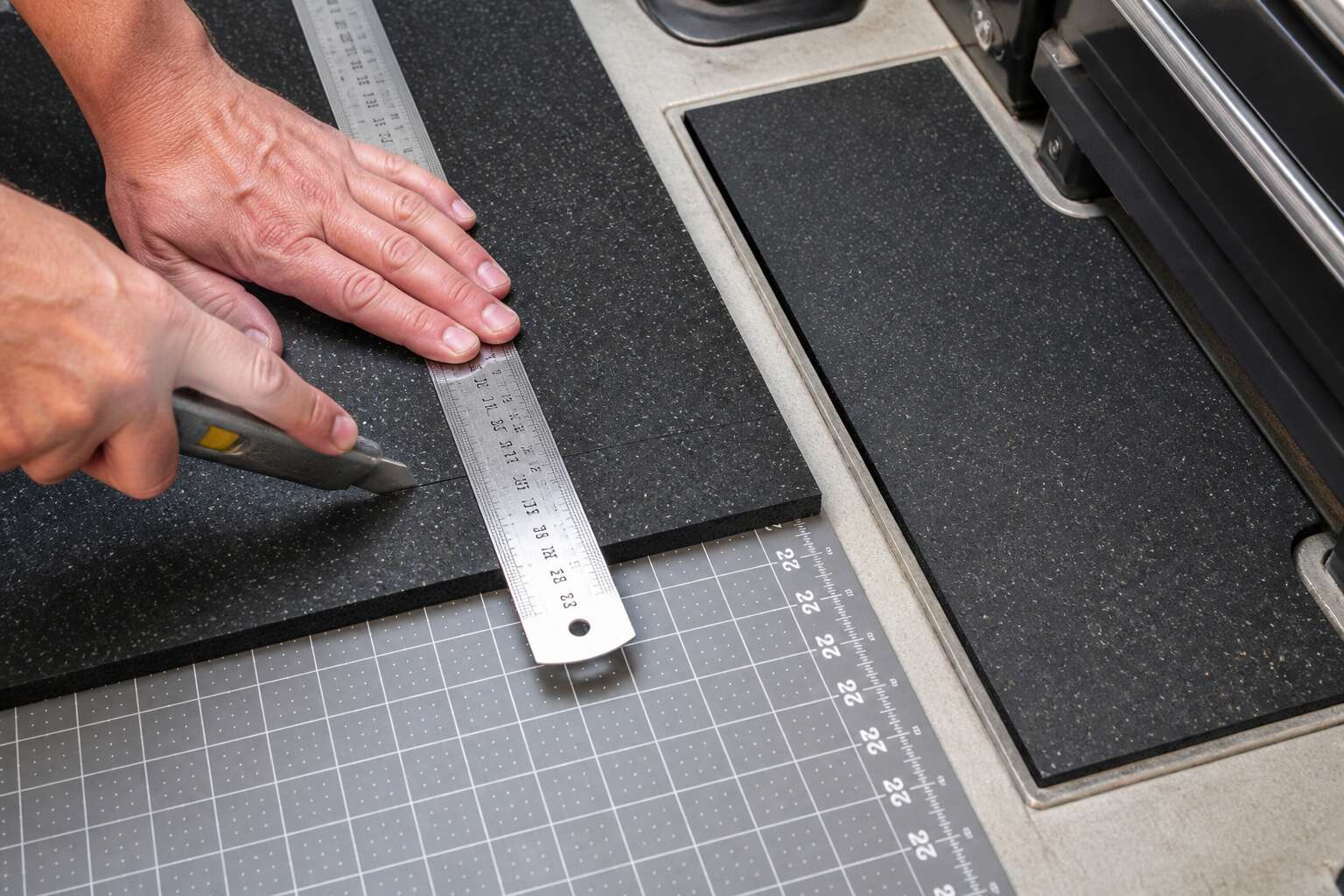
Adjustment is equally simple. Equipment moves, layouts change, and your floor covering should follow without friction. A sharp utility knife and a straight edge are the only tools required. Relocate a station and the rubber mat that can be cut to size moves with it, retaining its structural integrity through repeated handling.
This adaptability delivers tangible advantages:
- No special cutting equipment or factory lead times
- Precise fit around machinery bases and support columns
- Rapid reconfiguration when workflow demands shift
You maintain full control over the installation timeline. There is no waiting on custom fabrication or external contractors. The material responds to your schedule, not the reverse.
Durability and Longevity
Three years of continuous forklift traffic leaves most workshop floors scarred and crumbling. A rubber mat that can be cut to size looks the same on day one thousand as it did on day one. The dense compound compresses under load and springs back. That recovery is what delivers longevity.
This durability holds under South African conditions. Heat, dust, and chemical exposure do not break the material down. Oil and grease wipe off without staining. The matting stays flexible in winter and firm in summer.
What the surface endures:
- Point loading from heavy machinery feet
- Repeated impact from dropped tools and parts
- Abrasive grinding dust and metal shavings
Cut edges perform exactly like factory edges. A rubber mat that can be cut to size does not fray, split, or delaminate at the trim line. The integrity holds no matter how you shape it.
Selecting the Right Material for Your Project
Natural Rubber vs. Synthetic Rubber
Every mat tells a silent story of trade offs. Natural rubber, drawn from latex, offers pliability and a secure grip. It cannot withstand petroleum products. Synthetic rubber, by contrast, resists solvents and weather extremes. For a rubber mat that can be cut to size, your environment must dictate the decision.
I have seen workshops where a single chemical spill ruined a natural mat in minutes. Others required the cushioned feel only natural rubber provides, especially for workers standing all day. Examine your floors for moisture, UV exposure, and the precise chemicals in use. Then choose accordingly. There is no universal answer, only the honest conversation between material and setting!
Surface Texture and Traction
A wet workshop floor in Durban can turn a five minute task into a hospital visit. The surface texture of your rubber mat that can be cut to size determines whether that risk stays theoretical or becomes real. Smooth sheets look clean but offer little grip when oil or rain arrives. Crosshatch channels and raised diamond patterns displace liquids while keeping boot soles planted.
Traction depends on the interface between tread and foot. A mat with aggressive lugs suits a loading bay exposed to Cape Town’s winter drizzle. A finer texture works better for a retail counter where trolleys slide and staff pivot throughout the day. When you select a rubber mat that can be cut to size, consider the floor beneath it and the soles above it.
- Ribbed textures drain fluids quickly
- Diamond patterns balance grip and ease of cleaning
- Smooth finishes suit dry, interior spaces
The wrong surface texture creates slips in one direction and fatigue in another. Read your environment before you commit to a pattern.
Chemical and Weather Resistance
I watched a 20mm mat turn to green sludge in a Midrand workshop after one oil leak. A rubber mat that can be cut to size only earns its place when the compound matches the chemicals around it. That floor held engine oil, brake fluid, and a solvent that ate straight through.
Material choice is a practical assessment of the environment. Nitrile rubber stands up to fuels and petroleum. EPDM handles heat, ozone, and salt air along our coastline. Neoprene shrugs off acids and moderate weather. Each fails somewhere else.
- Solvent resistance matters near cleaning stations
- Ozone resistance matters on exposed roofs
- Temperature tolerance matters near furnaces
Weather compounds the problem. A rubber mat that can be cut to size for a loading bay in Gauteng faces UV, hail, and freezing winter mornings. The same sheet in a Durban yard fights humidity and salt. Look beyond the surface profile and study the polymer.
Color and Design Options
Blue for the workshop doors, grey for the plant floor, black for the walkways. It feels like a branding exercise. But the colour on a rubber mat that can be cut to size is rarely decorative. It signals function, and the wrong choice costs money.
Compound choice comes first. Colour follows the environment. A dark mat hides oil stains but heats a Pretoria warehouse by midday. A light mat reflects sun but shows every tyre mark. The surface profile does its own job:
- stippled textures grip underfoot
- ribbed channels drain liquids
- smooth finishes slide under pallets
The cut edge tells the truth about the compound. I have seen factory photos flatter a poor polymer. The sample piece in your hand does not lie.
How to Measure and Prepare for a Perfect Fit
Taking Accurate Floor Measurements
Most floor failures start with a careless tape reading. A rubber mat that can be cut to size cannot compensate for a measurement taken from a bent wall. I have watched installers ruin good material by rounding up to the nearest centimeter. Precision matters more than speed.
Clear the room and sweep the floor. Use a steel tape and measure the longest span in each direction. Record the numbers in millimeters. For odd-shaped spaces, divide the floor into simple rectangles and measure them separately.
- Measure at floor level, not from a skirting board.
- Take readings from three different points.
- Use the smallest figure as your cutting guide.
That final number becomes your template. The rubber mat that can be cut to size will sit flat if you honor those measurements. A few extra minutes now saves you from a wavy edge later.
Accounting for Door Swings and Obstructions
Nothing humbles a floor covering quite like a door that refuses to clear it. A rubber mat that can be cut to size still obeys the laws of physics, and a 12 millimeter mat beneath an inward swinging door is a recipe for splinters. Measure the door’s arc before you cut. Trace the swing path on the floor with chalk, then transfer that curve onto your template.
Obstructions demand similar respect. Chair legs, cabinet plinths, and the odd load bearing pillar all intrude upon your perfect rectangle. The workaround is straightforward:
- Cut a paper template of the obstruction’s footprint.
- Lay it on the mat and mark the outline.
- Trim with a sharp utility knife, leaving a 3 millimeter gap.
That gap matters. It lets the mat breathe and the door close. A rubber mat that can be cut to size will always respect a hinge that needs to swing.
Laying Out and Marking the Mat
The floor plan tells you where the mat belongs. The marks on the rubber tell you where to cut. A rubber mat that can be cut to size only performs as well as the lines you draw on it, so the marking stage deserves the same care as the measuring stage.
Start with a clean, dry surface. Dust smudges chalk and dulls markers. Roll the mat flat and let it rest if it arrived curled. Transfer your measurements with a straightedge and a fine-tipped marker. Work from the centre outward.
- Mark the four corners of your floor plan first
- Snap a chalk line between corners
- Trace any curves or obstruction cutouts last
- Double-check every mark against the original measurements
A rubber mat that can be cut to size forgives a crooked line, but only if you catch it before the knife comes out.
Transferring Measurements onto the Mat
A measurement transferred incorrectly is a measurement wasted. The gap between a perfect fit and a frustrating shortfall starts at the tape measure, not the knife. For a rubber mat that can be cut to size, the transfer stage determines everything that follows.
Start with a fixed reference point, like the longest wall or a door threshold. Lock the tape measure and mark from the same side of the blade every time. Repeat a 2mm error across twenty marks and you have a 40mm problem at the final corner.
- Mark the longest dimension first.
- Transfer secondary dimensions from that axis only.
- Check each mark against the original floor measurement.
A rubber mat that can be cut to size absorbs some human error, but only if you catch it before the blade moves. The line you transfer is the line you live with.
Planning for Seams and Multiple Mats
When a room exceeds the standard roll width, a rubber mat that can be cut to size demands honest seam planning. I prefer to place seams where foot traffic is lightest, away from doorways and heavy equipment paths. The location of every join deserves this level of thought!
Here is the sequence I follow:
- Measure each bay independently, never assuming the walls are square.
- Order the largest possible sheets first to minimise joins.
- Stagger the seams so they do not align with each other.
Butting edges together with a clean, straight cut is the goal. A slight bevel on each adjoining edge reduces the visible gap. For outdoor installations in the South African climate, allow a few millimetres for thermal expansion.
Step-by-Step Guide to Cutting and Customizing
Essential Tools for Cutting Rubber
Once your measurements are transferred and the seams are planned, the moment of cutting arrives. For a rubber mat that can be cut to size, the essential tools include:
– A sharp utility knife
– A straightedge or metal ruler
– A cutting surface you do not mind scoring
A carpenter’s square helps maintain clean ninety degree angles.
Begin by scoring along your marked line with moderate pressure. Do not attempt to cut through the full thickness in one pass. Repeat the scoring motion several times, allowing the blade to track in the existing groove. For thicker mats, a hooked linoleum knife offers better leverage. Keep your free hand clear of the blade path.
The result is a precise edge that fits your space without gaps.
Marking Techniques for Straight Lines
A straight line is the difference between a professional fit and a visible gap. When customizing a rubber mat that can be cut to size, the marking stage deserves the same patience as the cutting itself. Use a chalk line for long runs or a fine-tipped marker paired with a straightedge for shorter sections. Hold the straightedge firmly; any shift during marking transfers directly to the final edge.
For repeatable results, consider a simple sequence:
- Mark the start and end points with a small notch.
- Align your straightedge against both notches.
- Trace once, then check the line from both ends!
Verifying the line before cutting saves wasted material. This careful approach rewards you with a seamless fit that needs no adjustment.
Cutting Curves and Irregular Shapes
Cutting curves demands a different rhythm than straight lines. A rubber mat that can be cut to size around a pipe base or a corner post will punish haste. I prefer to draft a cardboard template first, then transfer the shape with chalk. This step saves material and nerves.
When the blade meets the curve, work in short passes. Use a fresh utility knife and score the surface lightly, then deepen the cut. For tighter radii, a jigsaw with a fine-tooth blade works well, but only on thinner mats. Always support the mat fully to prevent flexing.
For smoother results, follow this sequence:
- Trace the shape onto paper, then onto the mat.
- Cut 5 mm outside the line first.
- Trim inward gradually for a precise edge.
Irregular shapes are rarely perfect, but they need not look accidental. A steady hand and two or three passes beat one forceful cut every time. The mat will settle into place, hugging the obstacle with a fit that feels intentional.
Finishing Edges for a Clean Look
A clean edge is the difference between a mat that looks installed and one that looks dropped. Finishing edges properly transforms utility into craftsmanship.
First, sand the cut edge with medium grit paper. This removes the burr left by your knife. Second, heat the edge with a heat gun on low, just until it softens. Then press it with a flat block to create a slight bevel.
- Clean the edge with a damp cloth to remove rubber dust.
- Apply a thin layer of rubber sealant to prevent fraying.
- Buff with fine grit for a smooth, professional finish.
The heat method works best on thicker mats. On thinner ones, skip the heat and rely on sanding alone. A rubber mat that can be cut to size will always have visible edges, but they need not look sloppy.
Drilling Holes for Anchoring or Drainage
Drilling holes turns a rubber mat that can be cut to size into something that stays anchored or drains water, depending on your needs. Mark each hole with a centre punch first. This stops the drill bit from wandering across the surface. Use a sharp hole saw or a step drill bit for clean circles. Run the drill at low speed and let the tool do the work. Pushing hard only creates tears.
- For anchoring holes, drill through and fit stainless steel washers underneath.
- For drainage, space holes evenly and keep them at least 20 mm from the edge.
Countersink each hole to remove burrs before you finish the edges. South African thunderstorms demand proper drainage on outdoor mats. A rubber mat that can be cut to size handles both jobs well, provided you drill before that final edge treatment.
Maintaining and Extending the Life of Your Mat
Cleaning Tips for Different Surfaces
A mat’s worst enemy is often the very dirt it traps. Over time, debris grinds into the rubber surface, dulling grip and appearance. For a rubber mat that can be cut to size, maintenance hinges on the surface beneath it.
Smooth floors demand a damp mop with mild soap. Harsh solvents degrade the compound. Outdoor installations tolerate a hose and stiff brush to lift embedded grit. Indoor settings benefit from vacuuming first, then wiping with a vinegar and water solution.
- Textured surfaces respond well to soft bristle brushing
- Rinsing thoroughly prevents soap residue buildup
- Drying completely avoids slipping hazards
Concrete withstands pressure washing, while vinyl requires gentle handling. Testing a small corner first is prudent. A well maintained rubber mat that can be cut to size retains flexibility and resilience, extending its service life dramatically.
Preventing Lifting and Curling
Edges lift first. That is where a rubber mat that can be cut to size takes the most punishment. Foot traffic snags a loose corner, and the curl spreads inward. Temperature swings in South African workshops and garages make the rubber expand and contract, which compounds the problem.
Prevent this before it starts. A rubber mat that can be cut to size stays flat when it is allowed to relax after cutting. Unroll it and lay it flat for 24 hours before installation. For persistent curling, apply adhesive at the edges.
- Double-sided tape for smooth concrete floors.
- Construction adhesive for porous surfaces.
- Weighted objects along the perimeter during the first week.
Routine maintenance also plays a role. Sweep away grit that gets trapped under the edges. A lifted edge invites moisture underneath, which breaks down the adhesive bond over time.
Repairing Minor Damage
Every workshop mat eventually meets a sharp edge. A rubber mat that can be cut to size handles these encounters better when you respond quickly. Minor tears or cuts from dropped tools are common. Fill them with a rubber repair compound. For larger gouges, splice in a fresh section from your offcuts. Keep the repair flush and apply pressure overnight.
Routine inspection matters. Walk the perimeter and run your hand across the surface weekly. Grit and debris cause micro abrasions that weaken the mat over time. Addressing these small signs of wear prevents costly replacements. Pay attention to these weak points:
- Chemical spills leave softened patches near the surface
- Raised edges catch underfoot traffic at entry points
- Loose fibres unravel along the cut lines
A maintained mat keeps its shape and resilience for years, protecting your floor and your posture.
Seasonal Storage and Care
Seasonal shifts place real strain on any flooring material. In South Africa, the contrast between humid coastal summers and dry inland winters creates repeated expansion and contraction. A rubber mat that can be cut to size must tolerate these cycles. I have seen mats fail not from daily use but from improper storage during the off months.
Storage conditions matter. A rubber mat that can be cut to size holds residual stress from every cut line. Placed in a dark, cool space, it keeps its form. Exposed to sunlight or cold concrete, it degrades unevenly.
- Thermal shock from rapid temperature changes weakens the polymer matrix
- Contact with certain solvents leaves permanent softening
- Prolonged compression creates indentations
The mat’s response to its environment even when unused determines its resilience in active service.
Replacing or Repurposing Old Mats
Maintenance determines whether your mat survives a decade or disappoints within months. A rubber mat that can be cut to size responds well to regular sweeping and occasional rinsing with mild soap. Dirt acts as an abrasive between foot traffic and the rubber surface, embedding deeper with each step.
When the mat finally shows its age, consider repurposing before discarding. A rubber mat that can be cut to size still holds value in its unused sections. Cut away damaged edges and transform the remainder into workshop strips, kneeling pads, or protective layers under heavy equipment.
Practical second lives for worn mats:
- Trunk liners for vehicles
- Stall flooring for pets
- Underlayment for outdoor seating areas
This approach extends the material’s usefulness and delays the landfill.


0 Comments