Material Composition and Thickness
Rubber vs. PVC vs. Nitrile Blends
Thickness and Durability Ratings
The heart of any heavy duty rubber mat lies in its material composition and the thickness that follows. A 10mm mat feels different underfoot than a 20mm version, and the performance gap is equally vast. The polymers create a matrix that absorbs impact, yet the true test is the durability rating.
- Thicker does not always mean tougher, but it does change the load bearing capacity.
- The rating system, often measured in pounds per square inch, tells you if the surface will survive a workshop or a warehouse.
You want a structure that rebounds after heavy equipment passes over it, not one that permanently dents. That resilience, combined with the right gauge, defines the lifespan of a heavy duty rubber mat. For South African workshops, heat and UV resistance matter as much as the raw rubber itself.
Slip-Resistance and Surface Texture
The quiet hum of a workshop floor often goes unnoticed, but the surface beneath your feet works harder than any machine. A heavy duty rubber mat is not merely a passive layer; it is an engineered response to the chaotic demands of industry. The composition usually involves a blend of SBR and recycled crumb rubber, creating a dense cellular structure that holds its shape under relentless pressure. This alchemy of polymers gives the mat its body, a solid mass that absorbs vibration rather than transmitting it.
When you consider thickness, the difference is tactile and immediate. A thinner profile, around 8mm, offers a low-profile barrier for light traffic areas and tool stations, while a 12mm or 15mm slab introduces a deeper level of shock absorption for prolonged standing. The heavier gauge alters the way the material interacts with the ground, preventing the mat from curling at the edges or migrating across the concrete. It is this weight that anchors the mat, providing a stable platform that resists the shifting forces of pallet jacks and rolling loads.
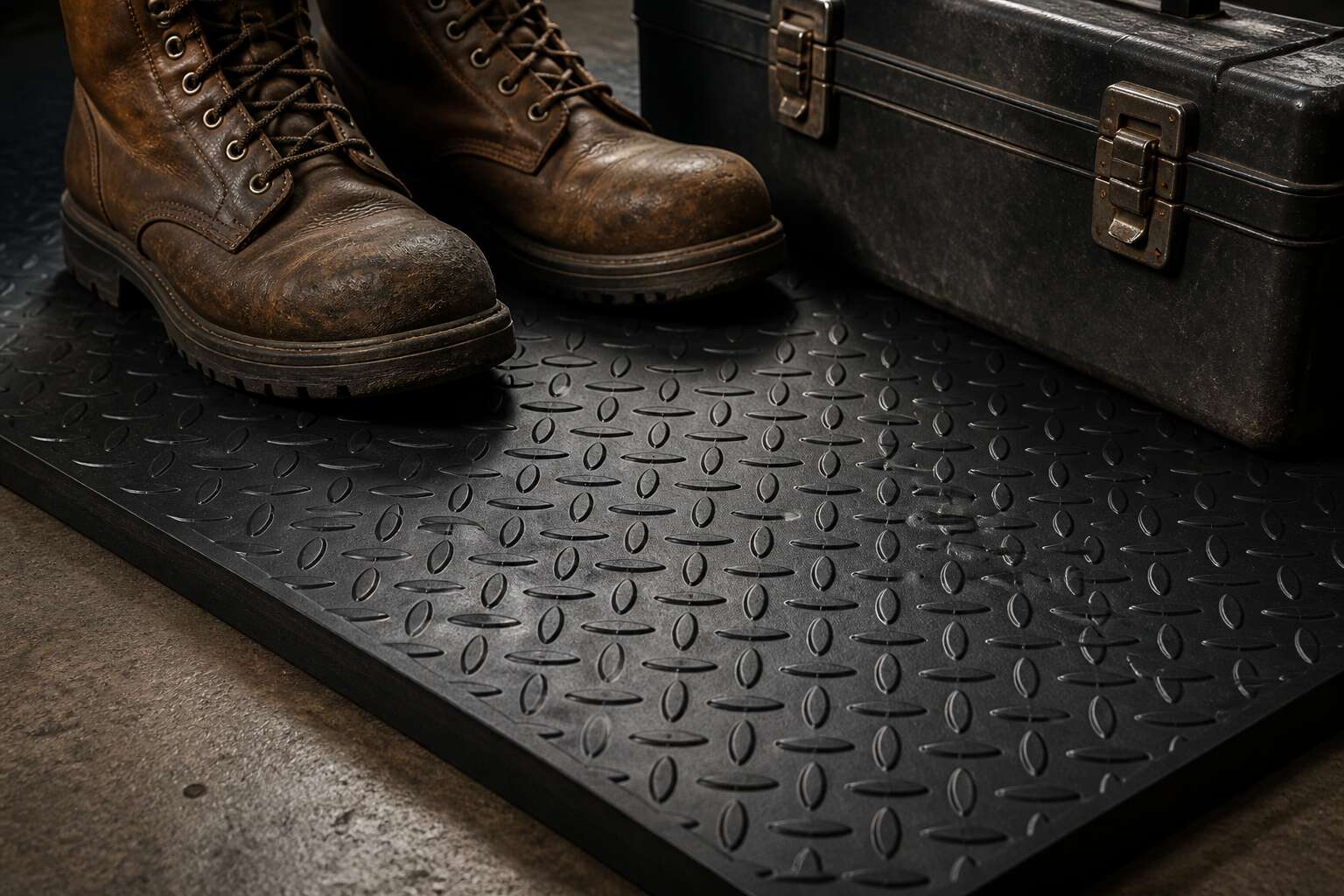
Yet, composition alone does not save you from a fall. The surface texture is the true guardian here. Look for a raised diamond or waffle pattern that breaks the surface tension of spilled oil or water. This channeling effect is critical in a country with variable weather, where moisture tracks in from the outside. The pattern must be aggressive enough to catch a boot heel, but not so aggressive that it becomes a trip hazard. The friction coefficient is a hidden spec, a silent promise of grip that works in tandem with the mat’s dense core.
– The ribbed underside creates a suction cup effect, locking the mat to the floor.
– A beveled border is not a cosmetic detail; it prevents the edge from catching underfoot.
– The texture must be self-cleaning, allowing debris to fall away rather than grind into the surface.
The true test of this flooring solution happens over years, not minutes. The synthetic rubber compounds are formulated to resist UV degradation, which is essential under harsh South African sunlight leaking through workshop doors. The material also shrugs off chemical splashes. Investing in a heavy duty rubber mat is a decision about the longevity of your comfort and the safety of your crew, a silent partner in every task performed above it.
Performance Benefits and Safety Features
Impact Absorption and Shock Reduction
When a tool clatters to a concrete floor, the resulting jolt travels straight up the arm and into the shoulder. That shock is not just an annoyance; it is a daily source of fatigue and long-term strain. A heavy duty rubber mat acts as a physical buffer, absorbing kinetic energy before it reaches your joints. The dense cellular structure compresses under pressure, dissipating the force across a wider surface instead of sending it directly into your body.
This shock absorption becomes critical in areas where workers stand for extended periods. Think of a metal stamping plant or a commercial kitchen where the ground is unforgiving. Without the right underfoot barrier, each step creates a micro-impact on the spine. Over time, that leads to chronic discomfort and reduced productivity.
Consider the specific benefits for task-oriented environments:
– Reduced vibration from mounted machinery
– Decreased breakage of dropped glass or ceramic items
– Lower instances of heel and knee pain at the end of a shift
The correct heavy duty rubber mats do more than just soften a fall. They create a safer zone for both person and property. By interrupting the chain of impact, they ensure that the energy from a dropped pallet or a heavy footfall does not turn into a workplace injury or an expensive repair bill. That is the quiet, practical work these mats perform.
Chemical and Oil Resistance
Spilled hydraulic fluid or caustic cleaning agents would ruin a lesser surface. The heavy duty rubber mat resists these substances because its vulcanized composition does not break down when exposed to petroleum products or industrial solvents. I have seen workshops where oil pools daily, and the mat remains intact without swelling or disintegrating.
Safety improves when leaks occur. A mat that withstands chemical degradation maintains its slip-resistant texture, even when coated in grease. Consider these advantages for your floor:
- Cleanup becomes quicker because the mat won’t absorb the spill.
- Worker confidence rises when footing stays secure near machinery.
- Replacement costs drop since the mat outlasts standard flooring.
That resilience also protects the concrete beneath, stopping corrosive liquids from etching permanent damage into the substrate.
Ergonomic Support and Fatigue Relief
Thermal Insulation and Electrical Safety
Your body loses heat rapidly when standing on bare concrete. That thermal drain is uncomfortable, and it also slows your work. A heavy duty rubber mat forms an insulating boundary, trapping warmth beneath your feet. In colder South African winters, this layer helps keep you productive.
Electrical safety deserves equal attention. Rubber is a natural insulator, so a well constructed mat prevents stray currents from reaching you. Consider these protective qualities:
- It blocks contact with live floor surfaces
- It reduces static discharge near sensitive equipment
- It remains stable even when damp or wet
Together, these features protect workers in workshops, garages, and industrial areas.
Primary Applications and Use Cases
Industrial and Manufacturing Flooring
In the hush of a Durban assembly plant, the floor endures constant punishment. Forklifts pivot, pallets drop, and steel-toed boots scuff the concrete. A heavy duty rubber mat alters this arrangement. It shields the substrate and provides a tolerably soft surface for workers who stand for hours, something we see matter in every facility we visit.
Manufacturing floors are not uniform. They shift between assembly lines, packing stations, and machine bays. Each zone demands something slightly different from the heavy duty rubber mat beneath it.
Common applications include:
- walkways between workstations
- machine operator platforms
- vehicle service pits
- sorting and packing areas
In fabrication workshops, the mat catches metal shavings and dampens the vibration of heavy presses. Maintenance teams appreciate how easily sections lift for cleaning or replacement. This keeps production moving without lengthy shutdowns.
Commercial Kitchens and Food Processing
Gym and Fitness Studio Floors
The gym floor is a proving ground for materials. The first brutal drop of a loaded barbell will reveal any weakness. For this reason, a heavy duty rubber mat is the bond between intention and impact. It captures the kinetic energy of a deadlift and the steady shuffle of a seasoned athlete on the treadmill. The material must absorb, deflect, and return, all while enduring constant foot traffic and shifting equipment.
These versatile surfaces find purpose in several critical zones:
The real measure of quality appears in the seams. A poorly made surface shifts under pressure or, worse, degrades under the weight of a loaded rack. A proper heavy duty rubber mat ensures structural integrity where it matters most, during the early morning or the final session of the day. It is the silent foundation for every personal best and every quiet recovery.
Automotive Workshops and Garages
The garage floor is a place of raw honesty. It holds the weight of a chassis, the spill of a coolant line, and the quiet frustration of a bolt that will not turn. A heavy duty rubber mat in this environment is not a luxury; it is a boundary between the human body and the cold, unyielding concrete. It defines the workspace, turning a patch of ground into a zone of focus.
Consider the daily rituals that occur in an automotive workshop. Tools slip. Grease drips. A technician kneels for hours to reach a stubborn component. The surface underneath must offer a reliable grip for both boot and creeper, and it must provide a cushion that pushes back against the fatigue of the afternoon. A heavy duty rubber mat absorbs the sting of a dropped spanner and provides a barrier from the chill that seeps up from the slab.
The true value of this material becomes apparent through its daily duties:
1. Protecting dropped tools from fracture and the body from sharp edges.
2. Providing a stable platform for creepers and jacks.
3. Creating a defined area that contains spills for easier cleanup.
The best workshops rely on this surface to mitigate the constant assault of oil, brake fluid, and battery acid. It is a quiet guardian, absorbing punishment so that the mechanic can concentrate on the work at hand. This is not about aesthetics; it is about creating a foundation that holds up to the relentless, gritty reality of the trade.
Agricultural and Livestock Areas
In South Africa, where the sun bakes the earth hard and sudden storms turn soil to mud, the ground inside a livestock pen or milking parlour faces relentless punishment. A heavy duty rubber mat changes the entire dynamic of daily farm operations. It provides a stable, dry surface that prevents animals from slipping on wet concrete, which is a primary cause of leg injuries and costly vet bills. The material also offers thermal insulation, keeping animals warmer during cold Highveld winters and cooler under the harsh summer sun.
Beyond the physical comfort for the herd, these mats simplify the most gruelling tasks of farm management. The non-porous surface blocks urine and waste from seeping into the underlying foundation, which stops the formation of corrosive ammonia pockets that erode concrete and create toxic fumes. When it comes to cleaning, a high-pressure hose is all that is needed to wash away the day’s residue, leaving the surface hygienic and ready for the next milking session.
For areas where animals stand for extended periods, such as feeding troughs or dipping stations, the cushioned resilience of the mat reduces stress on joints and prevents the development of painful conditions like sole ulcers. Here are some of the primary uses where this material proves indispensable:
- Milking parlours and holding pens where constant standing is required.
- Feeding lanes to provide a non-slip surface for cattle and horses.
- Loading ramps, where traction is critical to prevent panic and injury.
- Workshop floors in machinery bays where oil and grease are present.
Selecting the correct thickness is a critical decision; a 12mm to 15mm profile is often sufficient for sheep and goats, while heavier breeds like Bonsmara or Simmental require a denser 20mm option to provide adequate support. The ribbed or studded surface design channels liquids away from the animal’s hooves, which significantly lowers the risk of bacterial infections like footrot. This investment protects the health of the livestock and extends the usable life of the underlying floor, making it a practical choice for any operation focused on long-term productivity.
Selection Criteria and Sizing
Assessing Load and Traffic Volume
When sizing a heavy duty rubber mat, I start with what the floor will actually bear. A workshop moving mining components demands different support than a warehouse with foot traffic only. Assess the static load, the weight held in place, and the dynamic load, the weight that moves across the surface. That distinction shapes the effective dimensions of your mat.
Consider the frequency of traffic, the type of wheels or boots, and the duration of exposure.
- Forklifts and pallet jacks require thicker reinforcement and larger surface coverage.
- Pedestrian-only zones allow for lighter matting with a focus on slip resistance.
- Stationary machinery concentrates weight in small footprints, needing high compression strength.
Measure the floor area accurately, accounting for aisles and workstations. Undersizing a heavy duty rubber mat leaves gaps where fatigue and floor damage develop. Oversizing wastes budget without adding protection.
Environmental Factors and Temperature Ranges
Settling on the right dimensions is only half the battle. The other half is understanding where the mat will live and what it will face every single day. A heavy duty rubber mat that performs flawlessly in a Durban warehouse might crumble within a year if installed on a sun-blasted loading dock in Upington. The operational environment dictates the material formulation, not just the size.
Temperature swings are a silent killer for rubber compounds that aren’t specified for the job. Flexible materials stiffen below 10°C, turning a shock-absorbing surface into a brittle slab that cracks under impact. Conversely, conditions above 50°C can soften certain blends, causing them to deform permanently under static machine loads. You need to pinpoint the highest and lowest ambient temperatures in the actual installation area before you commit.
Exposure to fluids changes the equation entirely. Oils, solvents, and even intense sunlight alter the chemical structure of the rubber over time. Consider what is present in the space:
– Hydraulic fluids and diesel that swell and weaken general-purpose rubber
– UV radiation that dries out the surface, leading to cracking
– Extreme cold that reduces flexibility in non-cold-resistant compounds
Protective topcoats can shield against these agents, but they add cost. The wisest route is to match the polymer blend to the thermal and chemical reality of your site rather than overspending on unnecessary features. Also, consider the total weight distribution when temperatures peak, as a soft mat on a hot afternoon will react differently to a 4-tonne load than it will at dawn. This is why informed selection matters more than a vague assumption that thicker is always better. Environmental factors, measured against the actual load requirements, ultimately separate a sound investment from a costly mistake. When clothing and slag debris are part of the daily routine, the surface profile matters as much as the compound, but the base material remains the load-bearing foundation.
Customization, Rolls, and Interlocking Tiles
So how do you choose the right format for your space? The decision often comes down to coverage area and installation preferences. For large expanses like warehouse aisles or workshop floors, a heavy duty rubber mat supplied in rolls offers seamless coverage, eliminating trip hazards and reducing the chance of liquids seeping through joints. This format also allows for custom cutting, so you can fit the material around pillars, machinery bases, or irregular wall lines with a sharp utility knife and a straight edge.
In contrast, interlocking tiles provide unmatched versatility for smaller areas or spaces that require frequent reconfiguration. You can assemble them without adhesives, creating a stable surface that expands and contracts with temperature fluctuations. This modular approach simplifies replacement, because a damaged section swaps out in minutes without discarding the entire floor. Tiles also enable you to mix and match different surface textures, tailoring traction zones near entrances or workstations.
When determining what you need, consider these factors:
– Measurement accuracy. Always measure the longest and widest points, accounting for door swings and existing equipment footprints.
– Thickness requirements. A 10 mm roll often suits general workshop use, while a 12 mm tile better withstands heavy point loads from jack stands or pallet jacks.
– Transition edges. Ramps or beveled edges prevent tripping where the mat meets adjoining flooring.
Remember that rolls usually require more planning for delivery and handling due to their weight and rigidity, whereas tiles arrive in manageable boxes that maneuver through tight doorways easily. If you anticipate moving machinery in the future, tiles give you the freedom to adapt. If you prioritize uninterrupted protection over a long stretch, rolls deliver that continuous barrier. Ultimately, the correct heavy duty rubber mat aligns with both your current layout and your anticipated changes, ensuring you secure a surface that works as hard as your operations do.
Color Coding and Warning Surface Options
Selecting the correct heavy duty rubber mat is a decision that directly impacts workplace safety and operational efficiency. This is not a case of one size fitting all, and the choice often comes down to a detailed assessment of the specific environment where the mat will live. While the physical properties like thickness and material composition are critical, the process of sizing and planning the layout is equally important for achieving a professional, hazard-free floor.
The first step should always involve measuring the space with a critical eye. A heavy duty rubber mat is an investment, and the goal is to cover the required area without unnecessary waste or dangerous overlaps. It is essential to consider not just the static footprint of machinery but also the dynamic areas where workers move, especially where they stand for long periods. Failing to account for the swing of a door or the reach of a workstation operator can leave a gap in protection, which is a tripping hazard or a point of premature floor degradation.
When it comes to the physical selection, the three primary formats each serve a distinct purpose. Rolls are the most economical for covering massive, uninterrupted spaces, but they can be heavy and awkward to transport and position. Interlocking tiles have gained popularity for their ease of installation, requiring no special tools and allowing for simple replacement of damaged units. Cut-to-size sheets, on the other hand, offer a middle ground for those who need a custom shape but have a smaller area to cover. The correct choice is dictated by the required pattern and the access points to the facility. For instance, an interlocking tile is often the best choice for a room with a narrow doorway, whereas a roll might be more suitable for a large, open workshop floor.
Beyond the dimensional fit, the practical details of the mat’s edges and surface texture require careful consideration. A heavy duty rubber mat with a beveled edge is non-negotiable in areas where forklifts or pallet jacks cross the perimeter, preventing the wheels from catching and causing damage. Furthermore, the finish on the surface contributes significantly to the overall safety profile.
– Raised Diamond or Chevron: Provides maximum slip resistance and helps to scrape debris from shoes, ideal for entranceways and wet areas.
– Anti-Fatigue Studs: Offer a softer feel underfoot to reduce stress on the lower body, best suited for workstations where employees stand for extended hours.
– Smooth Surface: The most practical for easy clean-up in environments where spills are frequent, such as laboratories or specific manufacturing lines.
Ultimately, the path to a successful installation is found in the preparation. The condition of the sub-floor is a factor that cannot be overlooked, as a heavy duty rubber mat will simply transfer the imperfections of the concrete beneath it. A clean, dry, and level base is required to prevent the mat from shifting or creating uneven wear patterns. By taking the time to assess these specifics and matching the mat’s format to the physical constraints and operational needs of the space, you ensure safety and longevity are achieved, not just promised. A well-chosen mat is a silent partner in daily operations, conforming to the demands of the space it protects.
Installation and Maintenance Best Practices
Surface Preparation and Layout Techniques
Before a heavy duty rubber mat earns its place on a workshop floor, the ground beneath it demands respect. Surface preparation is not a formality. Concrete must be clean, dry, and free of oil residue. Old coatings compromise the bond. Uneven floors create pressure points that accelerate wear.
Layout begins with measurement. Allow the mat to acclimate to room temperature for 24 hours before installation. This prevents expansion or contraction later. For large areas, stagger the seams. A sharp blade cuts cleanly; a dull edge frays the rubber.
- Clean the concrete with a degreaser and let it dry fully.
- Roll the heavy duty rubber mat flat and check for warping.
- Mark cut lines with chalk, then cut from the top side.
Maintenance is routine. Sweep daily to remove abrasive grit, and wash with a neutral pH cleaner. Harsh solvents strip the protective surface layer, leaving it vulnerable to cracking.
Cleaning Procedures and Product Care
Installing a heavy duty rubber mat is only half the job. The other half happens after the forklifts stop moving. A regular maintenance rhythm prevents minor issues from becoming major expenses. Without cleaning, fine grit embeds into the tread and grinds down the surface. Vacuum dry areas with a stiff brush attachment to lift debris that sweeping misses. For ground-in grime, use a soft deck brush with warm soapy water. Avoid citrus-based degreasers, which can soften rubber over time. Rinse thoroughly with a hose, then squeegee dry to avoid standing water.
Product care also means monitoring the weather. South African sun accelerates rubber degradation. Prolonged exposure turns a dark mat chalky gray and brittle. Install a shade cloth or carport over outdoor mats. Indoor mats near north-facing windows benefit from a light covering. Under heavy equipment, inspect for indentations. Rotating the mat by 180 degrees every few months redistributes load. A heavy duty rubber mat subjected to constant sunlight or uneven pressure will fail long before its rated years.
Recognizing Wear Patterns and Replacement Timelines
A heavy duty rubber mat reveals its quality in the first month of use. Before installation, I always recommend acclimating the mat to room temperature for 48 hours to prevent shifting. Overlap seams by 50 millimeters on sloped surfaces to avoid trip hazards. After laying, tape the edges for the first week.
Patterns of wear appear early. Scuff marks that return after cleaning signal permanent deformation. A soft spot in the center of a heavy duty rubber mat indicates a void underneath. Track these indicators:
– Seam gaps wider than 6 millimeters
– Cracks deeper than 3 millimeters on the surface
– Soft spots that hold a fingernail impression
Measure these monthly. Most industrial mats last three to five years before replacement is due, depending on traffic and load.
Edge Management and Transition Strips
The quiet battle for a floor’s longevity is often won in the shadows, at the edges where the heavy duty rubber mat meets the concrete. This is the frontier, the exact point where curling begins its slow, insidious creep. A mat that lies flat in the center but lifts at the corners is a hazard in waiting, a trap for the unwary foot and the rolling castor alike. Installing a mat poorly is an invitation for premature decay, forcing an early replacement that could have been avoided with diligence.
Consider the transition between surfaces, a necessary evil where the mat’s robust thickness clashes with the unyielding flatness of a doorway or a loading bay. Without a proper ramp, the edge becomes a blunt instrument, impacting every passing wheel and heel. The solution lies in precision-cut transition strips, anchored securely to the substrate, not merely laid on top. These strips should bevel the height difference, creating a seamless glide rather than a sudden jolt. In the highveld heat, where temperatures swing dramatically, the adhesive itself must be chosen for flexibility to prevent the seal from fracturing under thermal stress.
A ritual of vigilance is required to maintain this integrity. Weekly, one must run a hand along the borders, searching for the subtle lift that signals adhesive failure. The environment dictates the cadence of this check; a workshop subjected to heavy forklift traffic demands a more rigorous schedule than a quiet storeroom. This is not a chore but a form of protection against a creeping entropy.
To ensure the perimeter holds, a specific order of operations is recommended:
1. Inspect all edges for signs of lifting or delamination from the subfloor.
2. Clean the boundary zone with a solvent to remove any accumulated grime.
3. Reapply a high-strength, pressure-sensitive adhesive specifically for rubber.
4. Roll the edge firmly with a heavy hand roller to ensure maximum surface contact.
Performing this sequence with regularity prevents minor flaws from escalating into a full-blown tear. The heavy duty rubber mat, once secured, becomes a monolithic shield, its boundaries as solid as its core. By mastering these transition points, the mat’s defensive capabilities are extended, ensuring the safety of every individual who crosses its threshold.


0 Comments