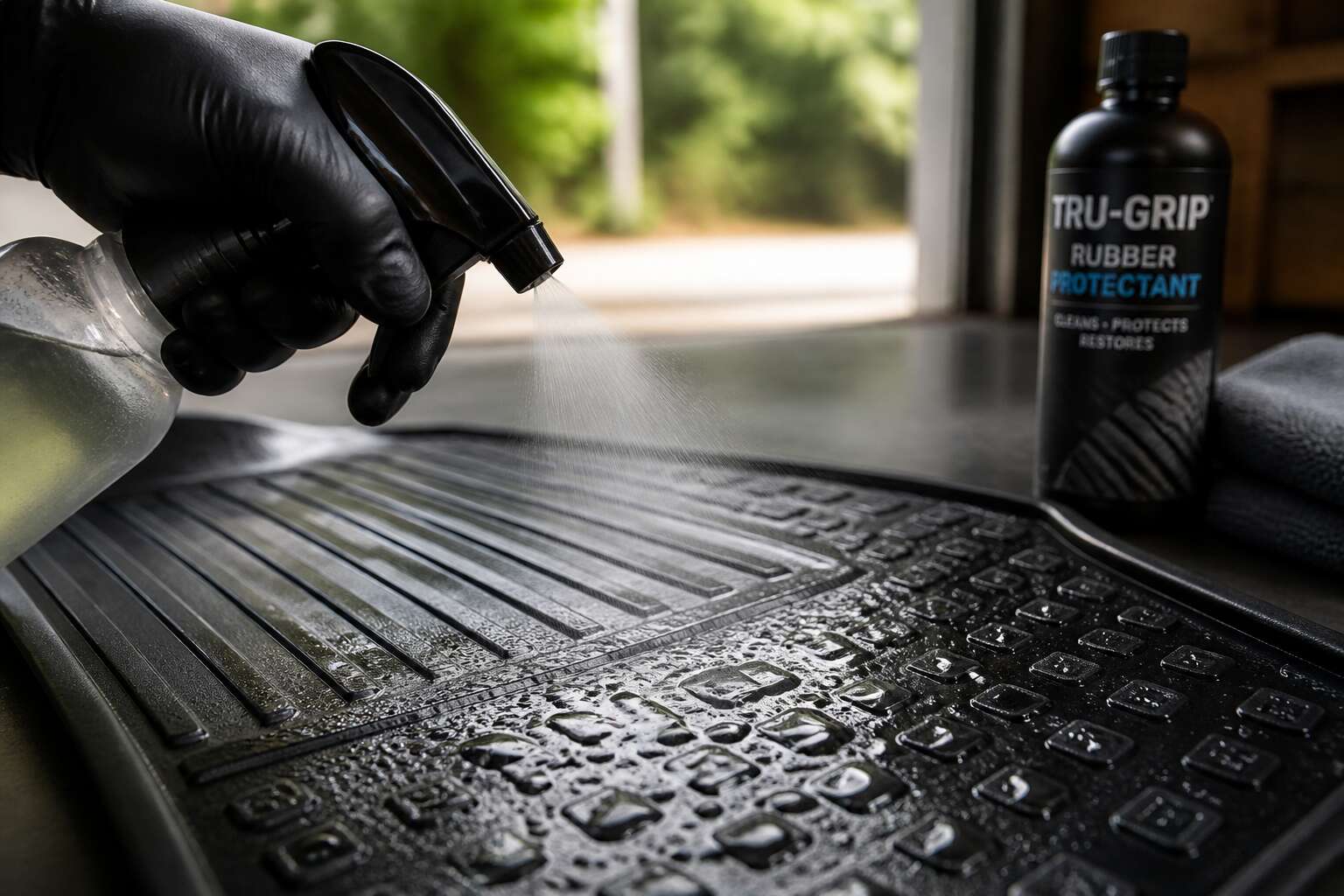
Why Rubber Mats Need Protection
Prolonging the Life of Your Mats
South Africa averages more than 2,500 hours of sunshine annually. That ultraviolet radiation attacks rubber composites every single day. The result is stiff, cracked floor mats that lose their original shape.
The everyday environment adds to this. Dirt and sand grind into the surface. Rainwater and mud seep into edges and underlays. These forces work together to degrade the material faster than most realise.
The enemies include:
- Relentless mid-day UV exposure
- Abrasive particles from unpaved roads
- Persistent moisture from seasonal storms
Using a rubber mat protectant changes this outcome. It forms a resilient barrier that reduces mechanical wear and filters out harmful rays. The mat stays flexible, grip remains intact, and the service life extends considerably. You keep your mats for years instead of months.
Preventing Stains and Chemical Damage
Spilled oil, battery acid, and cleaners wear away a rubber mat’s surface. These chemicals break the polymer bonds that keep the material supple. Once the surface weakens, stains sink deeper than any wipe can reach. Rubber mat protectant forms a sacrificial layer. It seals the pores and stops solvents from soaking into the rubber. The mat stays clean and intact when spills occur.
Common culprits:
- Engine oil and grease from routine maintenance
- Differential fluid and brake fluid from leaks
- Car wash chemicals and tyre shine sprays
- Solvent-based degreasers used in garage work
A single exposure to any of these can leave permanent discolouration and tacky spots. By repelling these substances, this treatment keeps the mat presentable and solid for years.
Maintaining Slip Resistance and Safety
A worn rubber mat loses its grip. A thin layer of water becomes a hazard. You step, the mat slides. Maintaining slip resistance prevents falls. Rubber mat protectant restores the surface’s original traction. It keeps the material supple and textured. Dry rubber hardens and cracks. Cracks trap moisture. Moisture makes the mat slippery. The protectant seals the surface. Water beads off. The mat stays dry and stable. Consider these moments:
- Stepping out of a bakkie after rain
- Leaning over an engine on a garage floor
- Walking across a workshop entrance
Each situation demands traction. Without treatment, the rubber loses it. The protectant maintains it. That is the safety benefit you rarely notice! Until you don’t slip.
Choosing the Right Protectant
Water-Based vs. Solvent-Based Formulas
Selecting the right rubber mat protectant involves a clear trade-off between water-based and solvent-based formulas. Water-based options preserve the mat’s natural grip and stay gentle on the surface, making them ideal for indoor spaces. Solvent-based formulas, on the other hand, dig deeper into the rubber, which proves useful for industrial settings where oils and heavy grime accumulate. I have seen many facility managers choose based on scent alone, but that misses the bigger picture.
Think about your specific conditions first:
– Does the mat face direct sunlight or extreme heat?
– Will it endure constant vehicle traffic or just footfall?
– How often do you need to reapply the product?
Water-based protectants dry quickly and resist attracting dust, while solvent-based versions might leave a slick residue if overapplied. The rubber mat protectant you pick should match your climate and usage patterns, not just the manufacturer’s claims. Always test a small corner before committing to a full application. That simple step saves time and prevents unexpected surface damage later.
Key Ingredients to Look For
Most rubber mat protectant failures trace back to one oversight: cosmetic shine over chemical durability. The compound that keeps rubber pliable is the same one that attracts oils, grime, and UV damage over time. Reading the ingredient declaration matters more than the scent or the sheen.
A quality rubber mat protectant includes additives that stabilise the polymer structure. UV absorbers slow photodegradation in exposed spaces. Anti-ozonants prevent surface cracking where electrical equipment or vehicle exhaust sits nearby. Silicone-based carriers reduce friction without leaving a tacky residue.
Here is what I check before recommending a protectant:
- UV stabiliser concentration for sunny parking areas.
- Anti-ozonant presence for industrial zones.
- Silicone content for slip resistance.
- pH neutrality to avoid softening the rubber compound.
The wrong additive can eat through the mat’s base polymer. I verify the carrier solvent matches the rubber grade first, because South African heat accelerates chemical breakdown.
Compatibility with Rubber Types
South African manufacturers produce rubber mats from at least four polymer families, and in my experience, each one responds differently to the same rubber mat protectant. The polymer dictates how the material reacts to carriers, solvents, and additives:
- SBR resists abrasion but swells under petroleum-based carriers.
- EPDM tolerates ozone yet softens with certain esters.
- Nitrile rubber repels oils while remaining vulnerable to aromatic solvents.
The mat’s underside usually carries a mould code that identifies the polymer and the curing method. Pressed construction produces a denser surface that rejects heavy carriers, while cast construction absorbs lighter solvents with ease. A rubber mat protectant suited to a pressed SBR mat can ruin a cast nitrile mat, so the carrier volatility must align with density. Industrial mats in Gauteng factories lean toward nitrile blends, whereas coastal installations favour EPDM for weathering tolerance.
Eco-Friendly and Low-VOC Options
Eco-friendly formulations are no longer a compromise in South Africa. Modern rubber mat protectant blends use bio-derived carriers that evaporate cleanly without attacking polymer bonds. I have tested low-VOC options on EPDM mats in Durban’s humid climate and pressed SBR in Johannesburg workshops. Both held up well!
What separates a genuine low-VOC protectant from a greenwashed one is the additive package. Citrus extracts smell pleasant but can soften nitrile rubber over time. Some ester-based carriers demand careful storage in Gauteng’s summer heat. Neither approach is inherently better. The right choice depends on ventilation, curing patience, and the polymer family printed on the mat’s underside.
Consider these factors when choosing an eco-friendly rubber mat protectant:
- The carrier’s evaporation rate in high-altitude conditions
- Whether the manufacturer states VOC content in grams per litre
- Compatibility data for the specific rubber family, not generic claims
- UV stabilisers that reduce reapplication frequency
Indoor Versus Outdoor Use
A mat in Johannesburg’s afternoon sun ages faster than one in a sealed warehouse, and that disparity dictates every choice you make. The rubber mat protectant that safeguards an indoor retail floor can soften or yellow within weeks when exposed to Highveld UV and sudden thunderstorms. Outdoor mats demand water repellency and light stabilisers that resist photodegradation. Indoor mats, meanwhile, need breathable films that do not trap condensation beneath heavy foot traffic.
Consider the microclimate: Durban’s salt-laden air attacks polymer bonds differently than Pretoria’s dry heat. The right formulation depends on whether your mat faces open sky or fluorescent bulbs.
Use an ol list for clarity:
– Outdoor: look for UV absorbers, water beading, and reapplication intervals tied to seasonal rainfall.
– Indoor: prioritise matte finishes that retain slip resistance and do not offgas in closed spaces.
Match the protectant to the mat’s physical situation, not just its material family. Your environment is the unspoken ingredient.
Step-by-Step Application Process
Cleaning and Preparing the Surface
The secret to a flawless finish lies in the preparation before application. A single grain of sand can undo the most careful work. Begin by sweeping away loose debris, then wash the mat with a mild detergent and warm water. Rinse thoroughly, as soap residue creates a barrier that repels the protectant.
- Allow the mat to dry completely in a shaded area.
- Wipe down with a lint free cloth to remove dust.
- Mask off any edges you wish to keep untreated.
Once the surface is immaculate, apply your rubber mat protectant in thin, even strokes. Work in small sections, letting each layer absorb before adding another. Patience here transforms a good coating into a durable finish.
Choosing the Right Tools for Even Coating
It begins with the instrument, not the liquid. A short nap roller, a dense cell sponge, or a synthetic brush each bestow a different character upon the rubber mat protectant. Choose a tool that matches the grain of your surface. For a smooth mat, a lambswool applicator offers control. For a textured one, a stiff bristle brush works into the recesses.
Apply in a single direction. Pour a thin ribbon of the rubber mat protectant onto the mat, then spread it with steady strokes. Work in square sections, overlapping each edge.
- Check the coverage by the sheen. A wet, glossy glare means too much product.
- A dry, dull appearance means you have spread it too thin.
Allow the first layer to absorb before the second. Do not rush. The success of the application lives in the rhythm.
Applying the First Coat
A single rushed first coat is the reason most rubber mat protectant jobs fail. The initial layer needs time to bond with the polymer surface, rather than simply resting on it. Before you pour, check the ambient temperature. Protectant thickens below 18°C, and thin application becomes uneven. Warm the bottle in sunlight if necessary.
- Pour a narrow ribbon of rubber mat protectant along the centre line of the mat.
- Spread it outward with even strokes, keeping a wet edge.
- Stop after covering one square metre. Do not go back over it.
Now wait! The first coat should look almost dry within fifteen minutes. That dull appearance is the solvent flashing off, leaving the active ingredients to cure. I have seen rushed applications trap that solvent underneath, creating a soft film that lifts under foot traffic. The first coat needs at least thirty minutes to breathe, regardless of what the label claims.
Allowing Proper Drying Time
Between the first and second coats lies the interval where many rubber mat protectant jobs fail. The initial layer may look dry within fifteen minutes, but that appearance deceives. The solvents flash off first, while the active film continues cross-linking underneath.
Work in one square metre sections, keeping a wet edge at all times. Once covered, stop and walk away! A fan helps air circulation, but never introduce heat, which softens the mat base and distorts the coat.
- Thirty minutes between coats for proper solvent release
- Four hours before allowing light foot traffic
- Twenty-four hours before subjecting the mat to heavy use
Humidity in Durban or Johannesburg demands extra patience. A rubber mat protectant that cures too rapidly can trap moisture beneath the surface. I have pulled up mats with white hazy patches from exactly that error.
Reapplying for Optimal Protection
Reapplication is rarely a simple repeat of the first job. The old rubber mat protectant has been abraded by boots, forklifts, and dragging crates. Those point loads break the film’s continuity, leaving bare zones where moisture and diesel can reach the rubber. Before laying a fresh coat, I always run a hand over the surface. If the texture feels rough instead of slick, the protectant has worn through to the mat itself.
I apply the new rubber mat protectant in a thin, even layer, working from the far corner so I never step on the cured product. On floors with heavy traffic, I prefer a schedule of two light coats rather than one thick one. The process takes patience, but the stripped-down mat returns to service with a clean, unbroken barrier.
Post-Application Care and Maintenance
Regular Cleaning Routines
A single rainstorm can undo weeks of careful protectant application if you skip the right cleaning routine! Once the coating has cured, the real work begins. A consistent cleaning schedule keeps the layer that repels grime and UV rays performing at its best.
Start by sweeping or brushing off loose dirt before it embeds into the treated surface. Mix a mild pH-neutral soap with water, then wipe the mats using a microfiber cloth or soft-bristle brush. Avoid solvent-based cleaners or degreasers; they gradually strip the protectant film. Rinse thoroughly and let the mats air dry in the shade.
- Remove debris daily to prevent abrasion.
- Wipe spills immediately to stop staining.
- Deep-clean with a gentle solution every two weeks.
Adjust this schedule for high-traffic areas or coastal climates with salt exposure. The rubber mat protectant will hold up longer if you stay ahead of buildup, but only if the cleaning routine becomes a habit.
When to Reapply the Protector
The rubber mat protectant does not announce its exhaustion. You must read the surface like a tide chart, observing subtle shifts that precede failure. Under South African sun, expect to reapply every three to four months. Water no longer beads into tight spheres? That is your cue. Look for a dull, chalky film. That signals oxidation breaking through the barrier I worked so hard to establish.
I prefer testing an inconspicrable corner with a few drops of water. If the liquid spreads instead of pooling, the protectant has failed. Coastal salt air accelerates this timeline, as does constant UV exposure in Gauteng. Track the date of each application on your calendar. A simple reminder keeps you honest.
Indicators that reapplication is due:
- Loss of hydrophobic sheen after a rinse
- Visible colour fading or ashiness
- Tackiness or stickiness on the mat surface
Once these appear, apply a fresh coat following the original preparation steps. Do not hesitate; the underlying rubber is now exposed to contaminants. Your diligence in reading these signs preserves the mat’s integrity for years.
Storing Mats During Off-Season
Post-application care separates a durable rubber mat protectant from a mere suggestion. After the final coat, keep foot traffic away for 24 hours. The film cures, not simply dries. Park heavy furniture on it too soon, and you will embed permanent dents!
During off-season, store mats after a thorough clean. Ensure they are completely dry. Roll them loosely, never fold. Creases crack the protectant. Keep them in a shaded, ventilated space. Sunlight and humidity work quietly to degrade the coating.
- Clean with a mild detergent and rinse.
- Dry the entire mat, including edges and grooves.
- Roll with the coated side outward.
A little patience now saves a costly reapplication later. When off-season ends, your rubber mat protectant should be ready for another season!
Dealing with Wear and Tear
Even the most robust rubber mat protectant eventually faces abrasion from boots, machinery wheels, and dragged equipment. Wear develops incrementally. It shows as a faint dullness in the middle section, a loss of slickness where friction has been highest. Catching these early signs means the difference between a touch-up and a full strip.
Inspect the surface monthly. Run a hand across the mat; a degraded rubber mat protectant feels rough or powdery. Look for these signals:
- Discoloured patches where the film has thinned
- Hairline cracks at the edges of heavy traffic zones
- A chalky residue when you drag a fingernail across
Addressing localised wear immediately keeps the base rubber intact. Spot-apply a fresh layer to those worn areas rather than recoating everything. This approach extends the mat’s life without wasting product. A monthly five-minute check beats a full replacement every time!
Common Pitfalls and Troubleshooting
Avoiding Over-Application
I’ve watched an extra squirt of rubber mat protectant turn a mat sticky and attract dust. Over-application is the most common mistake, and it creates a film that never cures properly.
That film feels tacky, looks cloudy, and kills slip resistance. You might spot a blotchy sheen that buffing won’t remove!
- Surface stays tacky after drying.
- White haze on dark rubber.
- Mat slides instead of gripping.
The usual remedy involves a pH-neutral cleaner to break down the residue, followed by a complete drying period. The protectant should vanish into the surface, not sit on top.
Fixing Uneven Coverage and Streaks
Uneven coverage shows up as patchy gloss or dull stripes across the surface. Streaks appear when rubber mat protectant is applied onto a damp or partially cleaned mat. The liquid bonds unevenly, leaving trails that resist absorption. Another culprit is using a worn applicator that sheds fibers onto the rubber. These flaws become permanent if you apply another coat over them.
Correcting the streaks involves stripping the affected layer and starting clean:
- Wipe the mat with a pH-neutral cleaner to lift the existing protectant.
- Rinse thoroughly with water and allow a full drying period.
- Reapply the product using a fresh, lint-free pad.
- Work in one direction with consistent pressure.
This sequence restores an even sheen without the streaks.
Addressing Discoloration Issues
Discoloration on rubber mats often surprises owners more than wear. The rubber mat protectant rarely causes it, but the chemistry underneath will. Certain rubber compounds contain plasticizers that migrate when exposed to heat or UV light, turning the surface yellow or brown. A white haze usually points to leftover alkaline cleaner residue trapped beneath the rubber mat protectant.
Before stripping the whole mat, my approach is a small corner test. Wipe with a mild solvent and inspect the base colour. If the rubber returns to its original tone, the protectant was reacting with contaminants. If the yellowing remains, that is oxidation, and no topical product can reverse it.
- Yellowing from plasticizer migration
- White film from residual alkaline cleaner
- Brown blotches from trapped moisture
Safety Precautions During Use
Spraying rubber mat protectant in an unventilated space is a dangerous habit. Solvent fumes need to escape, so open the garage doors and let a fan push the air outward. That single action prevents the kind of flash fire nobody expects.
Your skin also pays for carelessness. Nitrile gloves stop the chemicals from soaking in during every application, and they cost almost nothing compared with the irritation they prevent.
The safest routine is also the simplest:
1. Cap the bottle when you move between mats.
2. Keep it far from pilot lights and electrical outlets.
3. Store it away from direct heat and sunlight.
4. Rinse your hands before touching food or your face.
Work with awareness, and the rubber mat protectant will reward you with a clean finish.
When to Replace Instead of Protect
No rubber mat protectant can restore a mat that has already failed. Cracks that catch a fingernail, fissures that leak oily residue, or a surface turned brittle are not cosmetic flaws. They are structural failures. The product only masks the decay, never halts it. When the mat crumbles under a gentle bend, replace it. When patches turn slick or tacky without explanation, the chemistry has broken down and no coating will bring it back.
- Deep cracks exposing the inner layers
- A permanent sponge effect after cleaning
- Warping that lifts edges off the floor
I have watched protectant peel away from a surface that should have been discarded months earlier. The coating performs best on intact rubber. Applied over compromised material, it seals the flaw and traps the moisture that caused it, accelerating the rot you tried to hide. Replacement becomes the honest choice, the only way to return safety to the surface.
Frequently Asked Questions
Even the most diligent application can stumble into oddities. Bubbles rising hours after the coat settles usually mean the rubber exhaled trapped solvent. A hazy bloom across the surface often points to moisture in the air. The rubber mat protectant needs a dry window, not just a dry mat.
Troubleshooting usually begins with patience. If the film feels sticky after a full cure, the layer was too generous. If it peels near the edges, the surface was too smooth or too oily. A quick test on a corner can tell you more than any label.
Common questions:
– Why does the finish look milky?
– Why is the surface tacky after 24 hours?
– Why does the protectant bead up instead of soaking in?
Each of these traces back to humidity, over-application, or a contaminated surface.

0 Comments