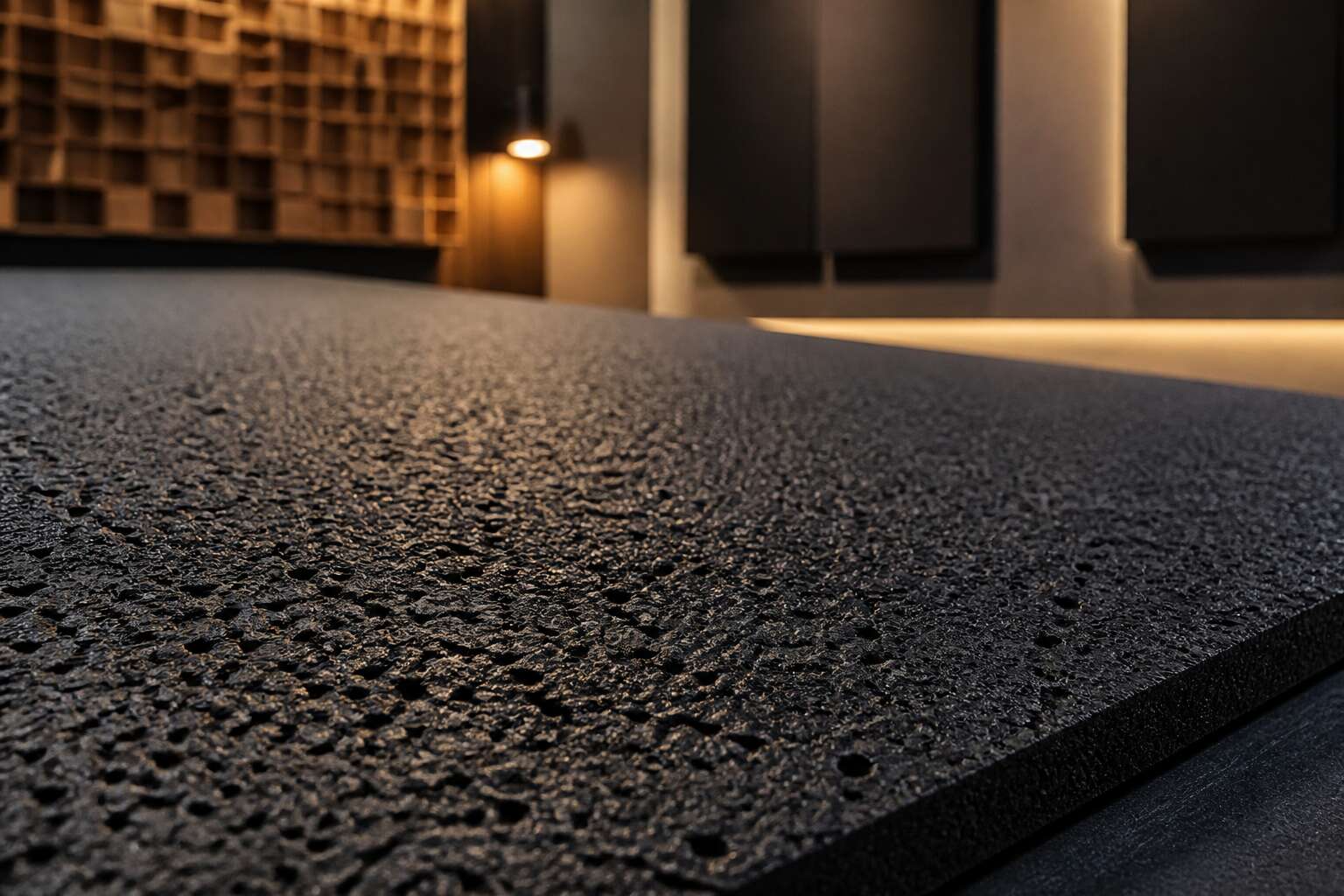
Understanding Acoustic Rubber Matting
Defining Acoustic Rubber Flooring
The persistent hum of daily life in South African homes and offices, from the rumble of traffic to the clatter of a home gym, is a constant source of subconscious stress. Acoustic rubber matting is not simply a floor covering; it is a physical barrier between you and the sound energy that pervades your space. This material functions by converting sound wave vibrations into negligible heat energy through its dense, elastic composition, effectively damping the resonance that makes rooms feel chaotic.
To define it clearly, acoustic rubber flooring is a manufactured membrane designed specifically to attenuate sound transmission. It is a technical solution that addresses both impact noise, like footsteps, and airborne noise, like conversations. The science relies on mass and decoupling. The rubber’s high density reflects sound, while its inherent flexibility prevents vibrations from transferring to the building structure. This is a mature technology, not a novelty, with a weighted sound reduction index that often surpasses other resilient surfaces.
The value of this material lies in its capacity to isolate a space, creating a private auditory environment. Consider what it replaces:
– Thin carpeting that traps dust and fails to block low frequencies.
– Hard surfaces like tiles or laminate that amplify footfall.
– Materials that degrade quickly under heavy weight and humidity.
This specific form of flooring is vital in multi-story buildings and high-traffic areas where structural noise is a primary annoyance. It does not merely mute the sound; it neutralizes the kinetic energy of the movement itself. By addressing the source of the vibration, the material prevents the physical discomfort that often accompanies noisy environments, fostering a sense of calm that is difficult to achieve through other means. It is a foundational element of architectural acoustics, prioritizing the psychological well-being of the occupants above aesthetic trends.
How Sound Dampening Rubber Works
Have you ever felt the thud of a heavy footstep travel through a concrete slab? That sensation is a structural vibration, and sound dampening rubber attacks it at the molecular level. The material’s viscoelastic nature causes polymer chains to stretch and relax under pressure. Each cycle converts mechanical energy into a tiny amount of heat. This process repeats thousands of times per second.
In practice, the rubber acts as a mechanical filter. It sits beneath a floating floor or under machinery. The critical mechanism is decoupling. Without a rigid connection, impact noise and airborne noise lose their path through the building frame. That is why this rubber matting acoustic layer requires a specific compression rating.
For rubber matting acoustic systems, three variables govern effectiveness:
- Material density
- Thickness
- Surface geometry
Primary Material Types and Composition
Around 70% of a rubber matting acoustic layer is often recycled crumb. The remaining 30% is where the engineering lives. I have seen mats fail simply because the filler ratio was wrong. Base elastomers, fillers, plasticisers and crosslinking agents are blended precisely. Most formulations start with SBR or EPDM.
For South African industrial settings, two families dominate:
- Styrene butadiene rubber, valued for abrasion resistance.
- Ethylene propylene diene monomer, better for weather exposure.
Each blend alters the cell structure. Closed cells resist moisture, open cells absorb sound. The crosslink density determines compression set. That is why two mats of equal thickness perform differently. The recipe is the real specification.
Key Benefits and Performance Characteristics
Reducing Impact Noise Transmission
The heaviest sound in a home is often not the loudest. It is the footfall, the dropped object, the vibration that travels through concrete and frame. Rubber matting acoustic systems interrupt that path at the floor surface, converting kinetic energy into heat through viscoelastic deformation. What matters is the measurable performance: reduced impact noise transmission means neighbours hear less of your daily life, and you hear less of theirs.
The key characteristics that deliver this separation include:
- High dynamic stiffness
- Dense cellular or solid composition
- Consistent thickness tolerance
These properties lower the impact insulation class rating. In multi-storey buildings, this translates to fewer disturbances during night hours. I have seen how residual noise shapes domestic tension. A quiet floor is not a luxury. It is a psychological buffer.
Sound Absorption Efficiency
Rubber matting acoustic does more than block footfall; it consumes airborne chatter. The open cellular structure traps sound waves, converting their energy into negligible heat. This is where sound absorption efficiency becomes a quiet advantage in offices and homes across South Africa, especially in spaces with hard surfaces like tiled floors or exposed brick.
- Reduces flutter echo in open-plan rooms
- Improves speech privacy without deadening a room entirely
- Maintains consistent performance even as temperatures shift
I have seen how a well-chosen mat can make a high-ceiling room feel more intimate. The material’s ability to handle both impact and airborne frequencies at once is rare among floor coverings. For anyone balancing noise control with daily life, this dual action is the real prize.
Durability and Long-Term Performance
The true measure of any flooring reveals itself after years of footsteps, dropped tools, and dragged furniture. Rubber matting acoustic performs with a resilience that feels almost unnatural, a lifespan often exceeding three decades in residential settings and up to fifteen years in commercial corridors. This longevity is not a happy accident. The vulcanised rubber composition resists compression set, meaning the material springs back even after a heavy desk sat on it for years, though a shift in South Africa’s heat can soften the resilience without cracking the integrity.
A performance characteristic worth noting is the material’s relationship with moisture. Coastal humidity in Durban or the dry Highveld air does little to alter its physical properties. It will not warp, swell, or become brittle, unlike many fibrous underlays.
– Resists indentation from heavy static loads common in office environments
– Maintains dimensional stability across temperature fluctuations from Cape Town winters to Limpopo summers
– Withstands incidental water exposure through spills or cleaning cycles without degrading the cellular structure
The long-term performance of rubber matting acoustic also reduces maintenance costs. There is no need for expensive chemical treatments or regular replacement schedules. Over time, the matt surface can be refreshed with a simple cleaning routine, preserving the acoustic dampening without sacrificing the underfoot comfort that made it a practical choice for domestic and industrial spaces alike. Every passing year of quiet is a testament to its structural honesty.
Thermal Insulation Properties
A 10mm layer of rubber matting acoustic can insulate a floor as effectively as 100mm of concrete, a fact that surprises most homeowners in South Africa. This thermal resistance means the material actively buffers against the cold that seeps through concrete slabs during Highveld mornings. It also keeps interiors cooler when the Karoo sun turns floors into heat banks.
The cellular structure traps air, creating a barrier that slows heat transfer. I have stood on this matting during a Cape Town winter and felt the difference immediately. The surface does not leach the chill from the foundation below.
– Reduces heat loss through ground floors by up to 25%
– Provides a stable underfoot temperature in rooms with underfloor heating
– Maintains its insulative properties even in high-traffic areas where the material compresses daily
This thermal performance works quietly alongside the sound dampening qualities. A home office becomes warmer and quieter, while a children’s playroom stays comfortable without extra heating. The material offers comfort that you feel before you even notice the silence it brings.
Applications Across Diverse Environments
Industrial and Manufacturing Facilities
Industrial and manufacturing facilities are noisy by design. Grinders, conveyors, and hydraulic presses generate constant noise that can obscure safety signals. Rubber matting acoustic solutions act as a direct intervention, placed where workers spend the most time. These mats reduce the clatter of foot traffic and dropped tools, making the space safer and more workable.
Consider the typical zones:
- Loading bays and dispatch areas
- Machine operator stations
- Warehouse aisles and sorting lines
Each zone requires a specific mat thickness and surface pattern. The overall din decreases, which helps workers communicate without raising their voices. As a facilities manager, I have seen this change the mood of an entire shift.
Home Gyms and Fitness Centers
The sound of a dropped barbell at 6 a.m. is a neighbor’s nightmare. In South African homes, converted garages host ambitious training programs. Fitness centers stack classes into shared footprints. Thuds and vibrations travel straight through concrete slabs. Rubber matting acoustic solutions change this physics quietly.
I have stood in a boutique studio where every landing footstep felt like a drumbeat. A 10 millimeter mat over the subfloor absorbed the punch. For home users, the benefit extends beyond politeness. The matting protects knee joints and keeps equipment from sliding mid rep.
- Cardio bays with treadmills and rowers
- Free weight platforms and squat racks
- Group fitness floors for high impact movements
Each zone demands a different density. A thick, patterned surface works under deadlifts, while a denser sheet suits spinning rooms. Rubber matting acoustic performance is measured by decibels, but felt as privacy.
Recording Studios and Broadcast Spaces
In a recording studio, silence is the product. Footsteps, chair castors, and equipment vibrations find their way into sensitive microphones. Rubber matting acoustic flooring isolates the control room from the live room. I have watched engineers walk barefoot across it, not for comfort, but because it guarantees that the only sound captured is the one they intend!
Broadcast spaces face a different problem. News anchors shift papers, camera operators glide, producers pace. Each movement sends a low frequency pulse through the floor. These floors absorb that pulse before it reaches the microphones. The result is cleaner audio and fewer retakes.
- Voiceover booths
- Control room walkways
- Green rooms
Commercial and Multi-Purpose Venues
Acoustic comfort decides whether a commercial venue feels professional or chaotic. In South African shopping centres, the sound of footsteps and trolleys travels through concrete slabs into retail units. Rubber matting acoustic underlayment stops that movement at floor level.
Conference centres and hotels face the same challenge. A delegate’s heel strike in a corridor can disrupt a presentation two rooms away. Rubber matting acoustic flooring absorbs those vibrations before they reach the structure.
Open-plan offices, restaurants, and multi-purpose halls all benefit from the installed layer beneath carpet, tile, or vinyl.
- Boardrooms and training areas
- Hotel lobbies and function rooms
- Retail showrooms and public corridors
The flooring works invisibly, converting impact energy into harmless heat and leaving speech clear and background noise low.
Residential Living Spaces
The Sunday morning lie-in is a fragile ritual. One heavy step above ends it. In South African homes, thin ceilings and tiled floors deliver every footfall to the room below. Rubber matting acoustic underlayment solves this at the source. It sits beneath laminate, carpet, or vinyl, absorbing impact energy before it reaches the structure of the house.
Sectional-title blocks and double-storey homes have different floor plans, yet the same problem. Neighbours share the same few centimetres of concrete. Rubber matting acoustic systems reduce the transfer. I have entered bedrooms where the silence felt noticeable because of this single layer. The trouble spots are predictable:
– Ground-floor kitchens beneath bedrooms
– Staircase landings above dining areas
– Passageways connecting bathrooms to lounges
The material itself remains unseen, yet its work is plain: a household where sound stays on the side of the floor where it began.
Installation Best Practices and Maintenance
Preparing Subfloors and Surfaces
A poorly prepared subfloor causes most acoustic performance failures. Industry repair logs attribute nearly 40% of installation issues to surface neglect. I have witnessed this in Gauteng warehouses and Cape Town studios alike.
Start with a clean surface. Sweep away dust, vacuum every groove, and degrease any oily patches. Moisture presents the next problem. Use a hygrometer to test the slab; readings above 75% demand a vapour barrier. Then inspect for cracks and unevenness. Fill gaps with epoxy mortar, and grind down high spots.
- Remove all existing flooring and adhesives.
- Repair structural cracks with flexible sealant.
- Self-level any dips deeper than 3 millimetres.
- Allow full cure time before installing the rubber matting acoustic.
Maintenance becomes predictable once the base is level and dry. Daily sweeping prevents abrasive grit from embedding. For spills, blot, never scrub. A pH-neutral cleaner monthly keeps the rubber matting acoustic surface resilient without stripping its protective layer.
Adhesive and Laying Techniques
Adhesive selection determines the lifespan of any rubber matting acoustic installation. I prefer a solvent-free polyurethane adhesive for prepared concrete slabs. Trowel it evenly, using a 2mm notched trowel for thinner mats and a 3mm notch for thicker profiles. Work in small sections, never exceeding the adhesive’s open time.
Lay the rubber matting acoustic with a rolling motion, pressing out trapped air as you advance. A 50kg roller over each seam guarantees full contact. Stagger the joints like brickwork to avoid continuous weak lines. After laying, keep foot traffic off for 24 hours.
- Seams should sit flush with no visible gaps.
- Edges near walls should be trimmed with a sharp knife.
- Adhesive should be fully cured, not just dry to the touch.
Maintenance starts with a soft brush vacuum attachment. This prevents grit from settling into seams. For adhesive residue on the surface, use a citrus-based remover, never a sharp scraper.
Sealing Seams and Edges
A seam left unsealed becomes a point of early failure. The edges of any rubber matting acoustic installation bear the most strain, and a small gap can grow into a loose flap. I use a polyurethane seam sealer matched to the mat’s hardness. Squeeze it into the joint, then strike it off with a damp finger for a flush surface. Wait for full cure before any foot traffic, usually overnight.
Edges against walls require a different approach. A metal or PVC edge trim secures the rubber matting acoustic and handles the movement that would otherwise tear an unsupported boundary. The trim also hides rough cuts, giving a clean sightline along the perimeter.
Maintenance is straightforward but demanding consistent attention:
- Inspect all sealed seams monthly for hairline splits.
- Clean any residue using isopropyl alcohol, never acetone.
- Apply fresh sealant the moment you see wear.
A neglected seam leads to premature floor failure. Take ten minutes each month to walk the floor with a torch.
Cleaning and Upkeep Guidelines
The South African climate tests every installation, from Highveld dryness to coastal humidity. Allow rolls to acclimate for 48 hours before cutting, which prevents dimensional movement once adhesive is applied. Never trust the written measurements; dry lay the material and mark cutting lines directly on the surface.
Maintenance demands consistency. Daily sweeping removes abrasive grit. Weekly mopping with a pH neutral cleaner handles the rest. Rubber matting acoustic responds well to a simple routine:
- Test every cleaner on a hidden corner first.
- Use a microfibre mop to limit water exposure.
- Blot spills immediately, never scrub.
The surfaces reward an honest routine and reveal any neglect through premature wear.
Safety and Building Code Compliance
A poorly installed acoustic floor is a liability, not an asset. In South Africa, building compliance for rubber matting acoustic installations often hinges on fire retardancy ratings and slip resistance classifications, particularly in commercial spaces. Verify that the chosen material meets SANS 10177 standards for flame spread before any adhesive touches the substrate. This is not a suggestion; it is a legal requirement for public buildings.
Surface preparation becomes a safety matter. A damp subfloor is a breeding ground for mould, which compromises indoor air quality and the adhesive bond. Contractors should test for moisture with a hygrometer, not guesswork. For coastal regions, a damp proof membrane is non-negotiable. Skirting and threshold transitions require careful planning to prevent trip hazards, especially where the flooring meets other surfaces.
Maintenance safety extends beyond cleaning agents. Heavy rolls of rubber matting acoustic require two people to manoeuvre during installation. Never cut material on the finished floor surface; a utility knife will score the backing and create a permanent groove. Use a dedicated cutting board off-site to protect both the product and your hands.
– Ensure all areas are well ventilated during adhesive application.
– Wear nitrile gloves when handling solvent based adhesives.
– Keep fire extinguishers accessible in storage and installation zones.
– Dispose of adhesive containers at registered waste sites.
Selecting the Right Acoustic Matting Solution
Evaluating Thickness and Density Needs
Seldom does a floor make you cringe, but a poorly chosen mat does exactly that. Selecting rubber matting acoustic requires evaluating thickness and density against your specific use case. A 6mm sheet might serve a home office, yet a factory floor demands 12mm or more. Density affects low frequency absorption; heavier material dulls hums, lighter versions only soften footsteps.
The source of noise changes the calculation. Machinery and impact produce different frequencies. I’ve seen installations fail when someone chose a thin product for a recording studio! The echo persisted despite the mat. Match mass per square meter to the decibel reduction you need. For South African buildings with concrete bases, denser rubber often outperforms thicker but porous alternatives.
Understanding Acoustic Ratings and Standards
Ratings can be confusing, yet they shape every buying decision. For South African readers, three figures matter most. Sound Transmission Class measures airborne noise, Impact Insulation Class tracks footfall, and Noise Reduction Coefficient shows how much sound a surface absorbs. Rubber matting acoustic performance depends on reading these numbers together, not in isolation.
Standards also differ across markets. European test results may not mirror local building requirements. Insist on a test report that matches your project conditions. Ask about edge sealing and mass per square metre. A strong rating on paper loses value if installation gaps undermine the floor.
Selecting rubber matting acoustic starts with verifying third-party data. Look for results tied to concrete substrates, the common base in South African structures.
Balancing Budget With Performance
Balancing cost and capability requires real data, yet rubber matting acoustic solutions offer a measurable advantage. In my experience, the cheapest option often fails within two rainy seasons, especially on South African substrates where moisture and movement test every seam.
Instead of fixating on price per square metre, weigh the full lifecycle. A thinner sheet might save R50 today, but replacement labour will erase that gain. Look for recycled rubber blends; they deliver similar performance without the premium. If you need to prioritise, note the hierarchy:
- Impact reduction takes precedence, since footfall dominates residential complaints
- Thickness matters only after confirming the subfloor’s condition
- Sealing materials require attention, as gaps void the entire investment
That approach maintains budget discipline without sacrificing the acoustic core!
Eco-Friendly and Recyclable Options
Selecting eco-friendly matting often means decoding vague labels. In South Africa, recycled rubber blends are common, but “recycled” sometimes means barely. I have seen mats with 2% reclaimed content sold as green. Check the actual percentage.
Recyclable options exist, but only if the binder allows separation. Examine the product data. Some matting uses virgin rubber for durability, but recycled rubber matting acoustic performs well when the granule size is consistent. That consistency matters more than the marketing story.
- Look for SABS certification for recycled content
- Ask about take-back programmes from local suppliers
- Confirm the matting does not contain heavy metal plasticisers
Eco-friendly selection is not about feeling virtuous. It is about preventing your acoustic solution from becoming landfill in five years. A mat that lasts longer and gets recycled properly is the only serious option.


0 Comments