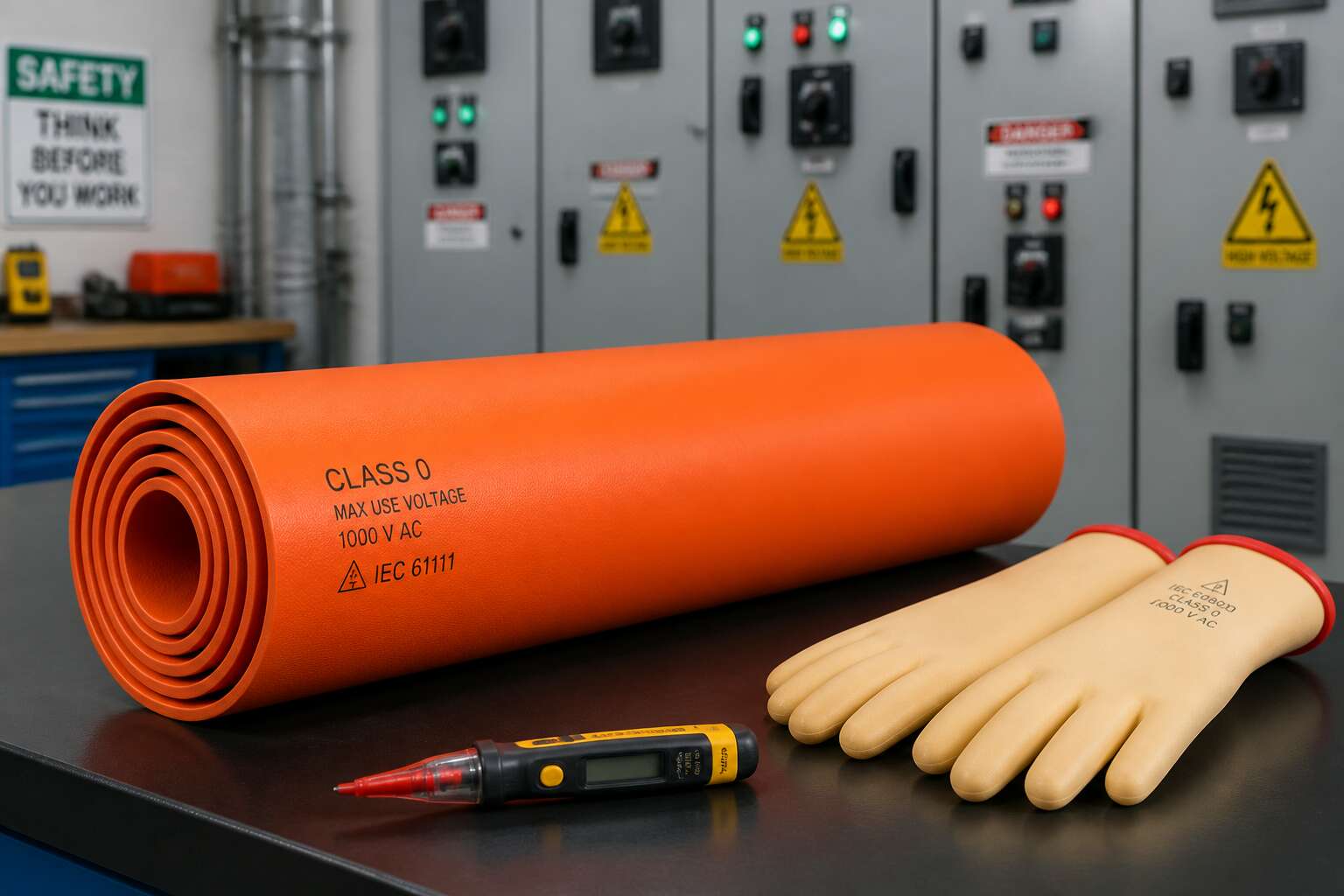
Understanding Voltage-Related Safety Flooring
Defining the Different Classes of Insulating Mats
Voltage does not announce itself. It waits inside live equipment, and the floor beneath a technician often decides the outcome. In South Africa, where industrial sites operate across variable grid conditions, insulating mats are a required component. They are a calculated safety measure.
The electrical rubber mat class 0 rating represents one end of the spectrum. These mats withstand alternating voltages up to 1,000 volts and direct currents up to 1,500 volts. To understand the hierarchy, consider the common classes:
- Class 0: maximum 1,000 V AC
- Class 1: up to 7,500 V AC
- Class 2: up to 17,000 V AC
Each class changes the point where human error becomes lethal. A higher class does not forgive carelessness; it only delays the consequence. Selecting the correct class requires reading the actual working environment, not the label alone.
The Specific Role of Class 0 in Low-Voltage Environments
The most deceptive current is the one that feels manageable. An electrician reaching into a 400 V panel does not experience the same dread as a linesman on a pylon, yet the heart stops identically. We treat low voltage as a known quantity, and that is precisely the risk. The electrical rubber mat class 0 exists for that exact moment of misplaced calm. It is a dielectric layer between a human body and an earthed floor, positioned there because the technician’s assumption of safety cannot be trusted.
An electrical rubber mat class 0 is engineered for low-voltage environments where the danger sits below 1,000 V AC. These are the spaces where work feels routine:
- Control rooms with live busbars
- Motor control centres
- Test benches for switchgear
Routine work produces routine hands, and routine hands make contact. The mat does not prevent the contact. It prevents the conclusion.
Key Terminology: Dielectric Strength, Breakdown Voltage, and Leakage Current
According to SANS 10084, an electrical rubber mat class 0 must survive 5,000 volts during a dielectric strength test. That number may look reassuring. The terminology behind it, however, deserves attention. Dielectric strength is the maximum electric field a material can endure without failing. Breakdown voltage is the point where it fails. Leakage current is the electricity that travels across the surface before or during that failure.
- Dielectric strength: the material’s resistance to electric fields.
- Breakdown voltage: the threshold where insulation becomes conduction.
- Leakage current: the unwanted flow that registers on a meter, not a spark.
These terms define the mat’s behaviour, not its label. You would be surprised how often engineers trust the label.
Why Rubber Is the Preferred Material for Electrical Insulation
Voltage-related safety flooring must endure more than electricity. It faces foot traffic, dropped tools, and slippery substances. A hard insulator might offer strong dielectric properties, but brittle materials fail when stepped on. Rubber is different. It absorbs impact, springs back, and keeps its shape.
The reasons are straightforward:
- Elastic recovery prevents permanent indentations.
- High friction coefficient works even with oil present.
- Closed-cell structure blocks moisture ingress.
An electrical rubber mat class 0 relies on this combination. The result is a floor that stays effective in conditions where rigid materials crumble. That is why rubber remains the standard for insulating surfaces.
Technical Specifications and Compliance Standards
IEC 61111 and Its Significance for Insulating Flooring
The gap between a safe switchroom and a fatal arc flash can be measured in millimetres. IEC 61111 is the standard that governs those millimetres. It defines the physical and electrical requirements that an electrical rubber mat class 0 must meet before it reaches a South African facility.
The standard sets limits for thickness, tensile strength, and elongation at break. It also demands rigorous dielectric testing. Every mat must withstand a specific test voltage without leaking current beyond acceptable levels.
Key parameters under IEC 61111:
- Minimum thickness of 4 mm for class 0 mats
- Proof test voltage of 5 kV AC
- Breakdown voltage of at least 10 kV
- Visual inspection and porosity checks
The significance for insulating flooring is verification. You receive a product tested against an internationally recognised benchmark. Specifying an electrical rubber mat class 0 means choosing documented performance over guesswork. That documentation matters during audits and when lives depend on a mat’s integrity.
Physical Dimensions, Thickness, and Surface Finishes
The physical specification for an electrical rubber mat class 0 reads like a bureaucrat’s love letter to precision. Minimum thickness is 4 mm. Tolerances matter. A mat measuring 3.8 mm at the edge fails compliance, regardless of how clean it looks. The top surface must be smooth or lightly ribbed per manufacturer design, while the bottom typically carries a corrugated pattern to prevent slippage and trap air.
Compliance verification involves dimensional and visual checks on every batch.
- Thickness measurement with calibrated micrometers
- Scanning for cuts, pits, and embedded contaminants
- Edge uniformity checks across the full roll
These checks matter inside a South African switchroom where an uneven mat creates a tripping hazard and a weak point. An electrical rubber mat class 0 with verified dimensions removes guesswork. You receive documented certainty, not an approximation, and that distinction shows up during audits and site inspections.
Testing Procedures for Electrical Resistance and Puncture Resistance
Every electrical rubber mat class 0 that fails a puncture test becomes a liability before it ever saves a life. Testing procedures for electrical resistance and puncture resistance follow strict protocols under IEC 61111. A sample is conditioned at 23°C and 50% relative humidity for 24 hours, then subjected to a 10 kV voltage across the material. Leakage current must not exceed a specific threshold.
For puncture resistance, a steel probe descends at a controlled rate. The mat must withstand the force without rupture. I measure this in practice: any tiny slit can compromise the dielectric barrier. We also run a sequence of checks.
- Visual inspection for voids.
- High-voltage withstand test.
- Puncture test with calibrated probe.
Each result gets documented for traceability. These tests separate certified protection from hopeful guesswork.
Temperature Ratings and Environmental Suitability
Most workers do not think about the rubber mat underfoot until the mercury swings or humidity creeps in. The electrical rubber mat class 0 operates within a thermal window, usually from -25°C to +50°C, and the manufacturer must prove that range. IEC 61111 requires the dielectric barrier to hold at both extremes.
Environmental suitability covers more than temperature. Ozone, UV, and chemical splashes attack the rubber. A mat rated for a warehouse may fail near a sunlit doorway or a solvent drum. The specification for any such mat should list tested resistance to these agents.
Some suppliers get specific. A typical technical data sheet would state:
- Temperature range: -25°C to +50°C
- UV and ozone exposure: tested for 500 hours
- Chemical splash resistance: verified per ISO 1817
Visual Inspection Criteria for Damage and Wear
What a spec sheet claims and what a mat has endured are two separate matters. Every electrical rubber mat class 0 in service carries a certification stamp. That mark records the standard, the class, and the test batch. South African buyers should request the certificate and confirm each mat against it. We see mismatched certificates often.
Visual inspection starts with the obvious. Cuts. Tears. Abrasion. Then look closer. Check for thinning where the surface has been compressed under loads. Inspect the edges and folding points where cracking often begins. Common failure signs include:
- Cuts or punctures exposing the dielectric core
- Embedded metal fragments or conductive debris
- Surface cracks from ozone or UV exposure
- An illegible stamp that removes traceability
Any one of these findings means the electrical rubber mat class 0 leaves service. Compliance standards require a documented inspection schedule, with results recorded and stored for audit.
Selecting the Right Insulating Mat for the Job
Assessing Worker Safety Risks in Your Facility
Choosing an electrical rubber mat class 0 demands more than a glance at the voltage rating. I have walked through countless plants where hazards hide under drip trays or beside workbenches. Your first task is to assess worker movement and the exact positions where hands might touch conductive surfaces.
Walk the floor during a shift. Note where ladders rest and how tools are handed over. That information shapes the mat’s coverage and orientation. Then check floor conditions. Oil, dust, or moisture can compromise a certified surface, so match the mat to the environment, not the electrical spec alone.
- Identify all earthed metalwork near the work zone.
- Map the paths workers take between energised equipment.
- Check for uneven subfloors that could cause tripping.
Only after this risk audit can you select the correct electrical rubber mat class 0 for each location!
Comparing Class Ratings Against Operating Voltages
Selecting the right electrical rubber mat class 0 for your South African facility means comparing the operating voltage with the mat’s certified ratings, not reading the label alone. Class 0 mats handle up to 1,000 volts AC, which covers most low-voltage switchgear. The operating voltage is only half the equation.
I ask facility managers to examine the test voltage and the maximum working voltage together. These figures appear on every compliant mat. A mismatch between the operating voltage and the mat’s class rating creates a weakness in your safety system.
- The system’s phase-to-earth voltage
- The maximum fault-withstand duration
- Whether workers stand on the mat while touching live parts
Every South African site has unique load profiles. The voltage at the transformer rarely matches the reading at the workbench. That difference is why the electrical rubber mat class 0 selection must rely on verified data, not assumptions.
Sizing, Coverage Area, and Anti-Fatigue Considerations
The most common sizing error is treating the panel footprint as the mat footprint. A mat that covers only the immediate front of a cabinet forces workers to step outside the insulated zone when opening a draw. South African panels often have wide breaker configurations. Measure the full working arc and add overlap so the electrical rubber mat class 0 remains underfoot at all times.
Anti-fatigue properties change how people use the mat. A comfortable worker stays positioned correctly. When feet tire, people shift, lean and step off the protected surface. The electrical rubber mat class 0 provides the dielectric barrier, but comfort determines whether the barrier stays beneath the worker. A quality mat balances both.
Storage and layout matter just as much. Large continuous mats reduce trip hazards; small mats create seams and edges. The configuration must match the floor plan and the technician’s actual movement pattern, which means walking the route before ordering.
Chemical and Oil Resistance: What to Look For
In many South African workshops, the insulating floor faces more than voltage. Hydraulic oil, cleaning solvents, and airborne ozone attack rubber over time. A mat that resists abrasion but swells on oil exposure can lose dimensional stability, creating gaps. Select a compound that tolerates the fluids present at your site.
- Mineral oils and greases
- Aromatic solvents
- Diluted acids and alkalis
- Industrial degreasers
Manufacturers rate the electrical rubber mat class 0 for dielectric performance under controlled conditions. Those ratings assume the surface retains its physical properties. When chemicals soften the rubber, the barrier degrades at a molecular level before visible damage appears. Quality mats include stabilisers that resist oxidation and oil migration.
Ask for the electrical rubber mat class 0 compound data sheet and compare hardness and elongation retention after immersion tests. That data shows real-world longevity better than the class marking alone. In environments with oil mist, regular wiping preserves the protection.
Brand Comparisons and Quality Indicators
Walk into any South African electrical supplier and you will see multiple brands of electrical rubber mat class 0. The price difference can be startling. That gap often reflects the quality of the raw polymer and the precision of the vulcanisation process. A cheap mat may pass a factory test once, then fail after a few months of foot traffic.
- Traceability: Does the mat carry a permanent batch number and test certificate?
- Surface density: Heavier mats typically have fewer voids and better puncture resistance.
- Edge finish: Clean, sealed edges prevent moisture ingress that leads to tracking.
Independent lab reports, not marketing data, reveal the true performance of a mat. A documented history of performance in similar South African environments matters more than the brand name.
Budgeting vs. Safety: Cost Considerations
Budgeting for an electrical rubber mat class 0 involves more than comparing shelf prices. The real cost reveals itself over time. A cheaper mat might reduce upfront expenditure, but replacement cycles shorten when the material degrades under constant foot traffic. In South African facilities, heat and humidity accelerate wear, so the economic equation shifts.
The purchase price represents a fraction of total ownership cost. Facilities that prioritise safety allocate funds for certified electrical rubber mat class 0 with documented performance. They treat the mat as protective infrastructure, not a consumable accessory. That perspective changes procurement decisions entirely.
Common cost factors to weigh:
– Replacement frequency driven by surface wear
– Downtime from mat failure during operations
– Liability exposure from electrical incidents
Every rand spent on a quality mat reduces the probability of unplanned expenses.
Installation, Maintenance, and Compliance Best Practices
Proper Storage and Handling Before Installation
Before a single electrician steps onto the surface, the electrical rubber mat class 0 must survive the transition from warehouse to workspace. Improper storage, such as folding or stacking heavy equipment on top, can create permanent creases that compromise dielectric integrity. Keep rolls upright on pallets, away from direct sunlight and ozone sources like motors.
During handling, use wide straps or spreader bars. Never drag the mat across sharp edges. Once laid, compliance depends on routine care. Clean spills immediately with mild detergent and water. Inspect the surface monthly for embedded debris or raised blisters. Adhere to the manufacturer’s refurbishment schedule.
For compliance audits, document installation dates and inspection logs. This evidence supports your safety file when regulators visit.
Surface Preparation and Cleaning Procedures
The floor beneath your electrical rubber mat class 0 demands exact preparation! Sweep away grit, then degrease with a mild alkaline cleaner. Rinse twice with clean water and let the concrete dry for four full hours. Any lingering dampness leads to blisters that silently compromise dielectric strength. Unroll the mat carefully, allowing it to relax before positioning. Use a roller to push air curtains outwards from the center.
>
For ongoing upkeep, clean monthly with neutral soap and warm water. Inspect seams and edges for wear. Record every service date and floor condition directly onto your electrical rubber mat class 0 compliance log. South African safety auditors appreciate this level of documentation, turning maintenance history into proof of diligence.
Routine Inspection Schedules and Record Keeping
Once the concrete is dry, electrical rubber mat class 0 installation becomes a matter of patience. Roll out the mat and let it settle overnight. Temperature shifts cause expansion and contraction, so leave a small clearance at the walls. Apply double sided tape only at the edges, never in the middle, to permit natural movement.
Routine inspection means more than a glance. Examine high traffic zones for punctures, embedded debris, and surface compression. Fold a corner of the electrical rubber mat class 0 and check for cracks along the bend. Clean with neutral soap, rinse thoroughly, and allow full drying.
South African safety auditors expect a written record. Maintain a log with the following details:
1. Inspection date and inspector’s name
2. Findings and corrective actions taken
3. Next scheduled inspection date
This documentation turns the electrical rubber mat class 0 into a verifiable safety asset. Without it, compliance remains an unverified claim.
Repair Techniques for Minor Cuts and Abrasions
A small cut in an electrical rubber mat class 0 can turn a safe workbench into a hazard. In South Africa, humidity and heat accelerate wear, so minor abrasions need immediate attention. A puncture becomes a pathway for leakage current.
Lift the mat and inspect both sides. Clean the area with isopropyl alcohol and dry it completely. For cuts under two millimeters, apply a vulcanizing repair compound in thin layers, letting each cure.
Repair steps:
- Trim loose fibres with a sharp blade.
- Sand the surrounding surface for adhesion.
- Press the compound firmly and level it.
Always test the repaired zone with a low voltage ohmmeter. Any repair must retain the original dielectric strength. If the cut reaches the conductive layer, replace the mat. Document each repair in your log to keep the electrical rubber mat class 0 verifiable!
When to Retire and Replace Insulating Mats
An insulating mat that looks sound can still leak current. Installing an electrical rubber mat class 0 starts with a flat, clean floor. Lay the mat without folds or curling edges, extending it beyond the work area to catch accidental contact. Use dielectric adhesive only where necessary, never staples or screws that puncture the rubber.
Compliance in South Africa means aligning your electrical rubber mat class 0 with IEC 61111 and your facility’s risk assessment. In our audits, maintenance that stops at sweeping is a frequent failure point. Check for brittleness from UV exposure or ozone, and wipe chemical spills off immediately!
- Retire a mat with visible cracks, embedded conductive particles, or permanent deformation.
- Retire a mat that fails a periodic dielectric test.
- Retire a mat after a chemical spill causes swelling or softening.


0 Comments