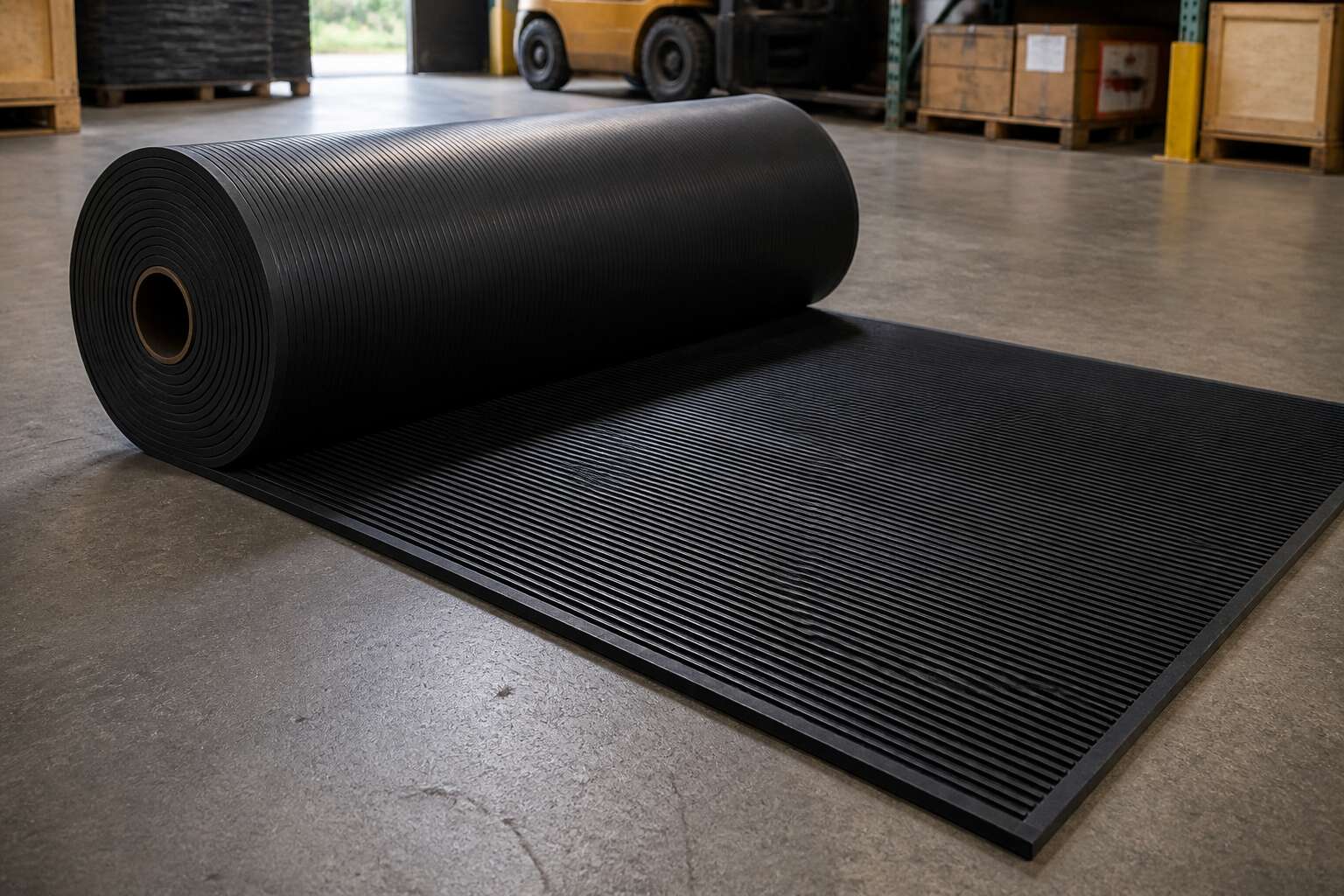
Essential Facts About Rolled Rubber Flooring
What Defines Heavy-Duty Rubber Matting?
Heavy-duty rubber matting absorbs extreme loads and surface impacts across South African factories and workshops. A reliable industrial rubber matting roll measures between 10 and 20 millimetres thick, with a density exceeding 1.0 g/cm³. These figures determine whether the floor survives years of abuse or fails within months.
What truly defines heavy duty matting? The material’s resistance to compression, oil, and chemical degradation. You can inspect a roll’s technical data sheet for these values. Thicker gauge does not always mean stronger, so verify the rubber compound itself.
Several properties deserve your attention:
- Compression set, which shows how well the matting recovers its shape
- Tear strength, a measure of durability under sharp objects
- Slip coefficient, essential for safety in wet conditions
Each property shapes the performance of your rolled rubber flooring installation in real working environments.
Advantages of Using Rubber Rolls Over Interlocking Tiles
A continuous industrial rubber matting roll outperforms interlocking tiles in demanding South African facilities. The seamless surface eliminates crevices where grime accumulates and where forklift wheels catch. Interlocking edges can separate under lateral stress, creating trip hazards that a rolled floor simply does not have.
Think about installation economics. A single roll covers substantial floor area in one piece, cutting labour hours dramatically. Tiles demand individual placement, alignment, and careful edge fitting. It makes no sense to piece together a factory floor tile by tile!
- Rolls handle heavy rolling loads without edge lifting
- Tiles become a maintenance burden when corners chip
- Rolled rubber keeps a uniform surface for hygiene compliance
Rolled rubber matting also copes with thermal expansion better than modular systems, holding its geometry when warehouse temperatures swing between extremes.
Typical Industrial Environments That Benefit from Rolled Rubber
Across South African industry, floors take a daily beating that would reduce lesser materials to rubble. The mining sector, in particular, demands surfaces that withstand abrasive dust and heavy impact. An industrial rubber matting roll provides a continuous barrier against this punishment, unlike modular systems that develop weak points at every joint.
One essential fact often overlooked is the role of backing texture. A rolled floor with a ribbed or waffled underside allows for air circulation, preventing moisture entrapment that leads to mould. This matters in facilities that undergo regular hosing or steam cleaning. The roll’s inherent flexibility also absorbs vibration from machinery, reducing noise pollution for workers.
Typical environments that benefit include:
– Processing plants where water and fat create slippery conditions.
– Assembly lines where standing operators need surface compliance.
– Loading bays where pallet jacks and forklifts perform tight turns.
The continuous nature of the roll ensures no shifting, which explains its dominance in facilities that value safety and longevity. It is a quiet solution for loud, demanding spaces.
How Rolled Rubber Improves Operational Efficiency and Safety
Downtime hides in the gaps between floor tiles, where debris gathers and seals fail. An industrial rubber matting roll removes those gaps entirely. The continuous surface is laid out and secured in one piece, which cuts installation time and eliminates the need for repeated joint maintenance.
The operational benefit is quieter than it sounds. Less cleaning effort, fewer repairs, and a stable surface for operators who stand for hours. That stability reduces physical strain, which lowers error rates across a shift. I have watched facilities slash their maintenance budgets simply by choosing the right roll.
- The roll’s closed-cell structure resists liquid absorption, keeping the floor hygienic.
- Its flexible backing grips the substrate without adhesives in most cases.
- A textured top layer channels spills away from foot traffic.
Safety is not a feature added later; it is engineered into the material’s response to pressure and motion. That response is consistent across every industrial rubber matting roll.
Selecting the Optimal Rubber Flooring Roll
Determining the Right Gauge and Thickness for Your Facility
A single millimeter of extra gauge can save a worker from a sprained knee or doom a forklift’s grip. Choosing the right thickness for your facility is a tactile decision. I often watch engineers press a thumbnail into a sample, searching for the sweet spot between cushion and stability.
In South Africa, where heat and abrasion punish surfaces, consider the load. A 6mm matting roll handles pedestrian traffic, while 9mm or 12mm suits heavy equipment. The substrate matters too. Uneven concrete asks for thicker material to bridge gaps.
- Assess peak impact zones: conveyor lines, assembly stations, loading docks.
- Measure the weight of your heaviest cart or pallet jack.
Your industrial rubber matting roll must flex without deforming permanently. Test for rebound elasticity. That resilience dictates lifespan.
Choosing Surface Textures: Ribbed, Diamond, or Smooth
Surface texture is the personality of your industrial rubber matting roll, and personalities clash in South African factories. Ribbed profiles excel at draining fluids and stopping slips near wash bays. Diamond patterns provide a stronger bite for forklifts and pallet jacks. Smooth surfaces make cleanup effortless, but they turn hazardous when oil arrives.
I once watched a facility manager choose smooth matting for a packaging line, only to replace it within a month. The caster wheels loved it, even if the workers did not.
Before committing, test each profile with your actual footwear and equipment. Ask these questions:
- Will water or oil hit this surface daily?
- Are you moving heavy loads or people?
- Do you need to wipe down the mat frequently?
The right texture matches the environment, not your aesthetic preference. That choice saves traction and sanity.
Material Composition: SBR, NBR, EPDM, and Recycled Rubber Blends
Polymer chemistry decides what your floor can tolerate. An industrial rubber matting roll made from SBR is a practical choice for general duty, but oil and prolonged sunlight will shorten its service life. NBR is the safer option where fuels and lubricants are present, since its nitrile structure resists swelling and breakdown. EPDM handles UV radiation and ozone with ease, making it a reliable candidate for open-air installations in South Africa.
Recycled rubber blends reduce upfront costs and absorb impact, although their consistency depends on the raw material source. Ask yourself these questions:
- Which fluids are present in the workspace?
- Will the mat be exposed to direct sun or rain?
- Do you need resistance to compression and tearing?
Understanding Roll Widths, Lengths, and Weight for Handling
A 10 metre roll of rubber matting can weigh as much as a compact car. That reality shapes every handling decision on site, and it catches many buyers off guard!
Roll widths typically run from 1 metre to 1.5 metres. Lengths stretch to 10 metres or more. A 6 millimetre thick industrial rubber matting roll weighs roughly 8 kilograms per square metre. Full rolls often exceed 250 kilograms.
The physical layout matters:
- Narrow doorways restrict access for tall rolls
- Corridors with sharp corners make long rolls awkward
- Stairways require additional manpower and planning
Ordering a heavier industrial rubber matting roll in shorter lengths reduces strain during installation. Wider rolls cover more floor area but demand lifting equipment. Supplier transport capacity and crew physical limits dictate the practical choice.
Customization Options for Unique Layouts and Branding
An industrial rubber matting roll in a standard dimension is a pragmatic starting point, but it rarely aligns with the irregularities of an existing floor. We have seen facilities where a single machine footprint, a drainage channel, or a loading bay threshold forces awkward overlaps and exposed edges. Customization closes that gap. Instead of patching pieces together, you order the roll manufactured to your exact spatial parameters.
Beyond dimensions, branding finds its way onto the rubber surface. Logos, safety symbols, and directional arrows can be molded directly into the material. Color choices, from subdued grey to high-visibility yellow, help define walkways and hazard zones without relying on paint that peels. Here are the options worth specifying:
- Custom cut lengths and widths for specific bays or corridors
- Pre-punched holes for bolts, stands, or drainage grates
- Embedded company logos or floor marking icons
- Different surface textures on a single roll for transitional areas
These choices turn a generic industrial rubber matting roll into a site-specific tool. For South African facilities managing tight budgets, the ability to eliminate waste and reduce installation time matters. A tailored roll arrives ready to lay, which means less cutting on site and fewer seams where dirt can collect.
Professional Installation and Care for Rubber Matting
Preparing the Subfloor for Proper Bonding and Adhesion
In Johannesburg, a rubber floor that fails does so because of dust, not traffic. Before any industrial rubber matting roll meets its adhesive, the concrete must be scrupulously clean, dry, and free of laitance. Sweeping alone is a polite gesture, not a preparation.
For proper bonding, grind or shot blast the surface to open the pores. Then vacuum the debris. Test moisture levels with a hygrometer; anything above 4% will compromise adhesion. Apply the adhesive evenly with a notched trowel, and allow it to become tacky before laying the roll.
- Remove all curing compounds and grease.
- Fill cracks with a suitable patching compound.
- Check for flatness using a straightedge.
Working with an industrial rubber matting roll demands patience. Rushing the subfloor is an expensive mistake, one that manifests as bubbles and peeling within months.
Seaming and Securing Techniques for Large-Area Coverage
Seaming an industrial rubber matting roll across a vast warehouse floor is a test of patience. The goal is a monolithic surface, one that hides its joints. A staggered seam pattern distributes stress, preventing gaps from opening under forklift traffic. Use a seam cutter or router to create a clean, even edge before applying seam adhesive. Hand-rolling the joint with a brass roller forces out trapped air and ensures full contact.
Securing the perimeter requires a different approach. Mechanical fastening at the edges prevents curling in high traffic zones. For large areas, a combination of adhesive and seam tape offers redundancy. Consider these factors:
- Seam orientation relative to traffic flow
- Expansion gaps at wall junctions
- Transition strips at doorways
Each decision affects long-term performance. An industrial rubber matting roll will expand and contract with temperature swings, so leaving room for movement is non-negotiable.
Regular Cleaning Methods and Chemical Compatibility
Professional installation and care for rubber matting depends on its chemical makeup. An industrial rubber matting roll will outlast its warranty when cleaned with pH-neutral detergents and lukewarm water. Harsh degreasers strip the surface oils that keep the rubber supple.
Regular cleaning means sweeping away abrasive grit first. Then rinse, scrub gently, and dry. Steam cleaning works well for oil-saturated floors but only at low pressure.
Chemical compatibility matters. Consider these agents carefully:
- Mild soap and water for daily upkeep
- Isopropyl alcohol for stubborn stains
- Diluted bleach solutions for disinfection
Solvents, acetone, and petroleum-based degreasers will soften and swell the rubber. An industrial rubber matting roll exposed to hydraulic fluid will deform if the spill sits unattended.
Preventive Maintenance to Avoid Tears, Curling, and Premature Wear
An industrial rubber matting roll demands respect during installation. The way you lay it determines how it ages. Heavy traffic and environmental shifts create forces that pull at edges and seams. Temperature changes are the primary concern. Rubber expands and contracts with heat and cold, so leave a small expansion gap at walls and fixed objects. This space absorbs movement and prevents buckling or tearing over time.
Prevent curling by pressing the material into the adhesive with a weighted roller, working from the centre outward. Air trapped beneath the surface creates bubbles later. Store heavy rolls upright, away from direct sunlight. UV exposure degrades the polymer structure, making the surface brittle.
Check seams monthly for lifting. I have seen this simple routine extend the life of an industrial rubber matting roll dramatically.
Performance Metrics and Regulatory Compliance
Slip Resistance Ratings and ASTM/OSHA Testing Standards
Slip resistance numbers look simple on paper, but they mask a world of friction coefficients and testing protocols. For any industrial rubber matting roll, the real question is whether it meets ASTM E303 or OSHA’s walking-working surfaces criteria. In South African facilities, from Durban’s humid warehouses to Johannesburg’s dusty workshops, these standards separate safe flooring from liability.
- ASTM E303 measures slip resistance using a pendulum tester, giving a value that correlates with real-world falls.
- OSHA’s guidelines, enforced under 29 CFR 1910, require a coefficient of friction of at least 0.5 for level surfaces.
A compliant industrial rubber matting roll delivers these numbers consistently, even when wet or oily. That consistency matters more than any marketing claim. Regular testing after installation verifies the performance remains intact.
Anti-Fatigue Benefits for Employees Standing on Hard Surfaces
Eight hours on unyielding concrete extracts a measurable toll. Research suggests standing workers face a 20% increase in musculoskeletal strain when the floor offers no give. An industrial rubber matting roll introduces controlled deflection that absorbs impact, slowing the onset of fatigue.
- Reduced lower back discomfort scores
- Sustained output rates across late shifts
- Lower reported foot pain incidence
Compliance follows the same logic. South African labour regulations place a duty on employers to mitigate ergonomic hazards. A properly specified industrial rubber matting roll satisfies those obligations while giving workers a surface that performs long after the shift grinds on. Now that is performance worth measuring.
Fire Retardancy and Electrical Insulation Properties
Fire and electricity remain two of the most overlooked hazards on an industrial floor. A standard rubber roll can turn a spark into a liability. I have watched compliance audits fail over a single missing fire test certificate. A properly formulated industrial rubber matting roll carries fire retardancy ratings that slow flame spread and reduce smoke generation. This matters for SABS and occupational health compliance audits, where non compliant materials fail without warning.
Electrical insulation adds another layer. Workers near live equipment or high voltage panels need a floor that resists current. The right industrial rubber matting roll provides dielectric strength, measured in volts per mil. That rating determines suitability for substations and control rooms.
A full specification review should verify these characteristics:
- Fire retardancy certification against SANS standards
- Dielectric test results from a third party lab
- Static electricity dissipation for explosive atmospheres
Chemical and Oil Resistance in Harsh Industrial Environments
Chemical and oil resistance is a performance metric that separates a durable industrial rubber matting roll from one that degrades within months. In South African facilities, exposure to hydraulic fluids, diesel, acids, and cleaning agents is routine. A matting compound that swells or softens in contact with these substances fails structurally and creates trip hazards.
Regulatory compliance in this area depends on documented test methods. The SABS standards reference immersion tests that measure volume change, hardness shift, and tensile retention after exposure. A quality industrial rubber matting roll holds its dimensional stability and grip characteristics even after repeated contact with aggressive substances.
Common agents to consider include:
- Mineral oils and lubricants
- Caustic cleaning solutions
- Dilute acids and alkalis
Performance data should match the specific chemicals present in your operation. Different polymer blends react differently to the same solvent.
Ventilation and Drainage Considerations for Wet Areas
Performance metrics in South Africa are not decorative. In our experience, an industrial rubber matting roll must meet documented standards for slip resistance and wear, but the SABS tests are only the start. A mat that passes in a dry warehouse can fail in a wet processing area.
Wet areas add another variable. If water pools under the matting, you have a microbial problem, not a safety solution. Ventilation matters as much as drainage. The surface profile must allow air movement and water flow, preventing trapped moisture from degrading the rubber.
Consider these drainage factors:
- Surface channels must be open and functional, not decorative
- Edges should direct water away from walk zones
- The backing must allow moisture to escape
Regulatory compliance is the baseline. The real test is whether the industrial rubber matting roll performs when wet, dirty, and ignored.
Economic and Environmental Considerations
Cost Breakdown: Rolled Rubber vs. Modular Tiles
Price per square meter is the obvious comparison, but it misses the labour, waste, and lifespan that determine what a floor actually costs. An industrial rubber matting roll of 6 mm SBR typically costs less than modular tiles of the same gauge. The difference comes from manufacturing. A continuous sheet is simpler to produce than interlocking units that require precise moulding and dimensional tolerance.
Installation costs reinforce the gap. A single industrial rubber matting roll covers a large area in one operation, while tiles must be placed piece by piece with each joint aligned and sometimes glued. A 100 square meter hall might take a two person crew several hours longer with tiles. That labour shows up on the invoice before the floor even sees a forklift.
Compare these cost drivers when evaluating your options:
- Material price per square meter for the same compound and gauge
- Installation labour, including surface prep and adhesive
- Service life and the cost of downtime during replacement
- Offcut waste and the disposal fee per kilogram
- Replacement strategy for damaged sections
Environmental impact follows the same logic. Choosing an industrial rubber matting roll over modular tiles changes the waste profile from the start. A rolled floor generates fewer offcuts because the sheet is cut to the room’s exact dimensions. Modular tiles produce waste at the factory, during cutting, and again whenever a damaged tile is replaced. Recycling programs for rubber flooring exist in South Africa, but they only accept clean material. Contaminated rubber, especially from oily environments, often ends up in landfill. Fewer cuts mean less contaminated waste.
In my experience, transport is the one area where tiles hold an edge. An industrial rubber matting roll is dense and awkward to move. Tiles arrive in compact boxes that a single person can carry. For a small space, that convenience might justify the higher unit price. For a warehouse or production floor, the cost per square meter, the installation hours, and the waste disposal savings all favour the roll.
Calculating Square Footage and Minimizing Waste During Installation
Calculating square footage starts with the longest and widest points of the floor, then adds a modest allowance for seaming and trimming. Rooms that look rectangular often hide deviations that shift the final cut line by several centimetres. Those centimetres decide whether an industrial rubber matting roll covers the space in one continuous sheet or leaves a shortfall.
- Record the longest length and widest width separately
- Note pillar bases, door frames, and drainage channels
- Add 2% to 3% for cutting error and seam overlap
Waste is where economic and environmental costs converge. Offcuts are dense, and disposal in South Africa is charged per kilogram. Rubber contaminated by oil or grease cannot enter recycling streams, so every unnecessary trim becomes permanent landfill. Accurate measurement before ordering reduces offcut volume and lowers the total cost of the floor.
Sourcing Strategies: Buying Direct from Manufacturers or Using Distributors
Sourcing strategy affects your carbon footprint. Buying direct from a manufacturer of industrial rubber matting roll cuts out freight consolidators, but requires bulk ordering that ties up capital. Distributors offer local stockholding, which shortens delivery distances and lets you order only what you need. In South Africa, transport emissions often exceed the embodied energy of the rubber.
Direct purchasing suits facilities with predictable, recurring square meterage. Distributors earn their margin by absorbing storage costs and offering credit terms. Some also manage waste take-back schemes where recycling infrastructure exists. Before committing, weigh these factors:
- Lead times and warehousing expenses
- Bulk pricing versus per-metre rates
- Return policies for defective batches
When you source an industrial rubber matting roll in bulk, a distributor’s nearby warehouse can justify a higher unit price by cutting freight emissions. A direct factory order earns volume discounts, but leaves you responsible for freight and stock management. The right route depends on your cash flow, floor size, and environmental targets.
Recyclability and Green Certifications for Sustainable Rubber Flooring
The rubber under your feet today could be a mulch bed tomorrow. Industrial rubber matting roll waste is not a dead end. Recyclers granulate spent matting back into crumb rubber, and that crumb finds new life in shoe soles, playground surfaces, and even fresh matting. In South Africa, the tyre recycling industry has built collection networks that now accept rubber flooring offcuts.
Green certifications matter when you buy. I look for third-party labels like GreenTag, FloorScore, and SABS eco-markings. These verify that an industrial rubber matting roll stays within VOC limits, uses responsible material sourcing, and avoids heavy metals in pigments.
To evaluate a supplier’s environmental claims:
– Check for a documented recycled content percentage
– Ask whether the factory recycles its own production waste
– Verify the certification is current, not expired
A certified roll often costs more per metre. That premium buys lower long-term liability, and your sustainability report gains real credibility!
Long-Term ROI and Warranty Insights for Capital Planning
Capital planners often fixate on the upfront metre price. That figure obscures the real economics. A certified industrial rubber matting roll with a documented lifespan of a decade or more spreads its cost across thousands of operational hours. Warranties translate environmental claims into financial protection, and I have seen too many buyers skip this step. Before signing a purchase order, scrutinise the warranty terms for delamination, UV degradation, and chemical attack.
A robust warranty should cover:
- Manufacturing defects in the rubber compound
- Adhesion failure between backing and surface
- Premature wear beyond the agreed millimetre threshold
A warranty that excludes installation errors should give you pause. Environmental considerations align with financial sense in one respect: a roll that lasts longer requires fewer replacements, which reduces landfill contribution and procurement cycles. That alignment matters in South Africa, where logistics costs for a single industrial rubber matting roll can exceed the material price itself.


0 Comments