Why a Dedicated Rubber Mat Set Matters for Your Defender
Protecting the Original Floorpan from Mud and Moisture
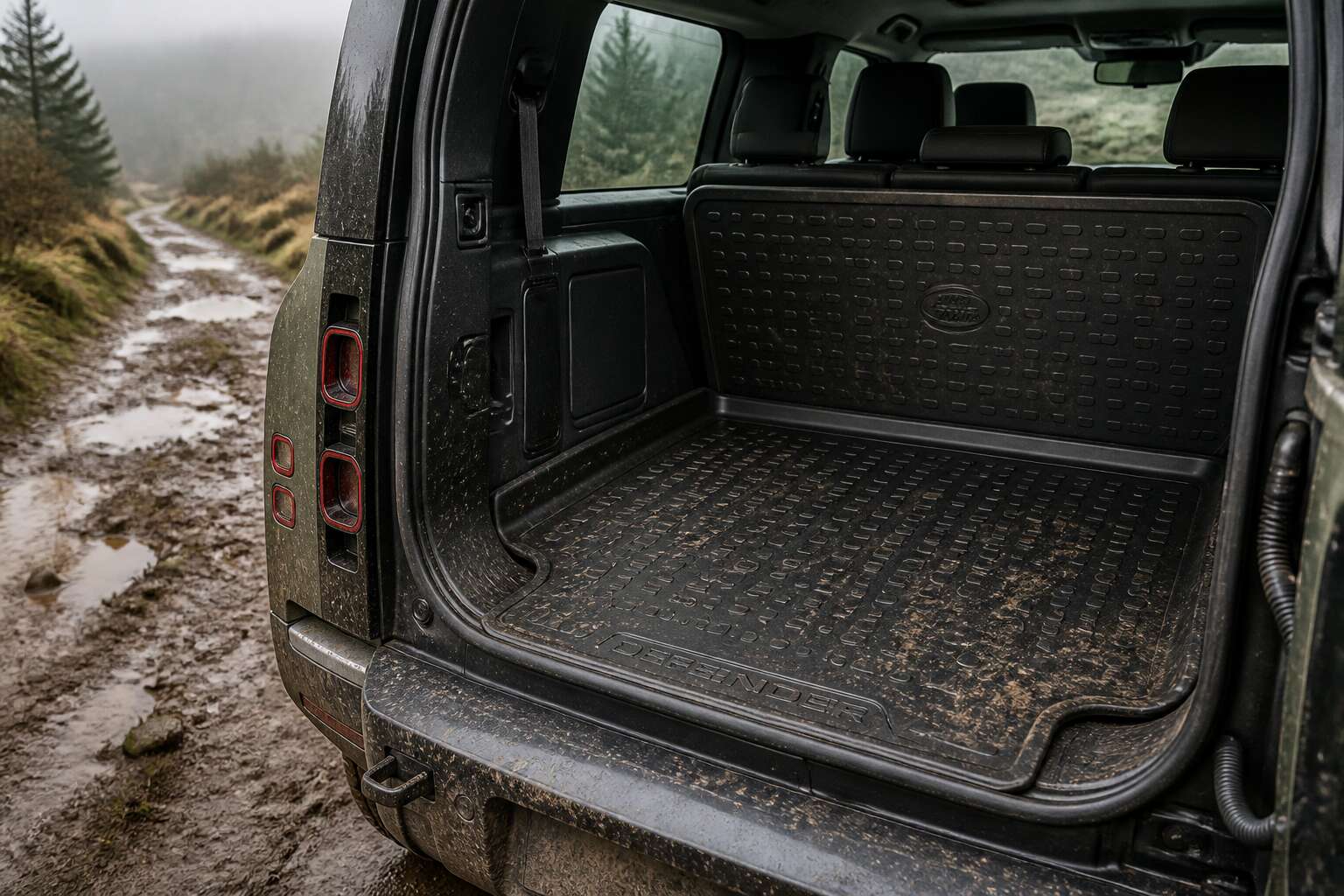
South Africa’s red dust and seasonal downpours have a way of finding every crevice of a Defender. The original floorpan, that pressed steel foundation, silently endures a constant assault. A land rover defender rubber mat set acts as a barrier between your boots, the weather, and the metal beneath.
Mud cakes into the ribs of the floorpan, trapping moisture that leads to corrosion. The dedicated mat set is molded to fit those contours, not a universal rectangle that slides around. It keeps the factory coating intact.
- Captures dripping water from wet gear.
- Stops abrasive grit from wearing through paint.
That protective layer turns a simple ride home from a trail into a low maintenance routine. Without it, the floorpan becomes a grimy archive of every off-road trip, and rust starts its quiet work.
Resale Value and Interior Preservation
The resale ledger of a Defender is written in the condition of its cabin. An untouched footwell tells a prospective buyer that this vehicle was maintained, not merely driven. A land rover defender rubber mat set quietly safeguards that story, protecting the factory carpet and sound deadening from the slow erosion of boots and gear.
Consider the heel of a boot twisting against a rubber tread. That motion, repeated over thousands of kilometres, leaves grooves in the original floor covering. Those grooves are permanent. They are evidence of hard use. A dedicated mat set intercepts that wear, preserving the interior so that the cabin presents as a time capsule rather than a confession.
- It blocks the deep scuffing of high traffic areas.
- It holds the original surfaces in a nearly untouched state.
- It strengthens the position of a seller by keeping the cabin honest.
When you finally open the door for a handshake, a preserved interior becomes a quiet argument for your asking price. The land rover defender rubber mat set is a small investment that prevents the irreversible fading and compression of the factory floor. That preserved finish is what separates a well cared for Defender from a forgotten one.
Grip and Stability for Off-Road Adventures
On a rocky ascent in the Cederberg, the last thing you need is your foot sliding off the pedal. A land rover defender rubber mat set delivers the tactile connection that keeps you in control. The tread pattern grips your boot soles, while the backing locks onto the floorpan. No shifting, no bunching, no surprises.
Consider the conditions:
- Wet mud from the trail
- Dust that turns to slick paste
- Steep inclines that demand precise throttle work
Each element tests your footing. The mat’s raised ribs channel debris away from your heel, so the contact point stays consistent. Your inputs remain measured. The vehicle responds predictably. That stability keeps the descent controlled, even when the terrain turns chaotic.
Noise Reduction and Acoustic Insulation
The Defender’s cabin has a distinct acoustic signature. On the long N1 stretch near Gariep Dam, that signature becomes a drone. A land rover defender rubber mat set alters this. The dense rubber acts as a mass-loaded barrier, absorbing resonant frequencies that bounce off the bare floorpan. The mats block the transmission hum that travels up the gearbox tunnel.
Beyond mass, the land rover defender rubber mat set provides a sealing function. The mats lay flush against the factory contours, closing gaps around the pedal box and footwell vents. This stops the high-pitched whistle at 120 km/h! Consider the sounds that vanish:
- The gravel pinging off the sills
- The tyre roar from coarse asphalt
- The metallic rattle of a loose tool in the footwell
This soundproofing layer means I can hold a conversation without raising my voice. It also lets me hear the engine’s mechanical responses instead of its complaints.
Key Features to Evaluate Before Buying
OEM Fit vs. Universal Fit: Understanding the Difference
An ill fitting land rover defender rubber mat set causes dirt and frustration. It shifts, curls, and lets moisture seep past its edges. The first decision is fit, not color. It is the fit itself. OEM mats are molded to the exact contours of your Defender’s footwell. Universal mats require compromise. Evaluate the depth of the lip, the rigidity of the edge, and the location of retention posts. A proper fit seals as it covers. That matters!
- The thickness of the rubber, which prevents buckling under heel pressure.
- The pattern of raised channels, which direct water away from pedals.
- The inclusion of a mat retention system that clicks into existing factory anchors.
Universal options often lack that final detail, leaving a mat that moves. For a vehicle built to traverse the Karoo, a land rover defender rubber mat set requires precision.
Material Thickness and Durability for Long-Term Use
I have pulled enough tired mats from Defenders to know the difference between a 4mm thick rubber mat and a 2mm one. The difference shows up years later. Thin rubber stretches at the heel pad, then tears. Thick rubber, with a higher carbon black content, resists that fatigue. It also copes better with the heat of a Northern Cape summer.
The key is not sheer bulk. It is the compound itself. The markers of a durable mat include:
- a Shore A hardness around 70, which resists cracking in the cold and softening in the heat
- carbon black content, which guards against UV degradation
- a textured underside that grips the floorpan without adhesives
A land rover defender rubber mat set built this way survives decades of farm boots and wet dogs. It holds its shape. It keeps doing its job long after cheaper options have turned brittle and split.
High-Rise Edges and Deep Channels for Liquid Containment
One hundred millilitres of water can hide in a single boot tread after a wet morning in the veld. That is why the high-rise edges and deep channels of a land rover defender rubber mat set matter. A flat mat lets that water bleed straight onto the floorpan. The raised lip, typically 25mm to 40mm, holds the liquid in place. Deep channels keep the water below the tread surface.
Evaluate these details before you buy:
- Edge height at the rear, where water pools under braking
- Channel depth, and whether the channels drain to a single low point
- Lip stiffness, which must resist folding under a heavy foot
A land rover defender rubber mat set with a 30mm edge and 8mm channels contains the water. Tip it out at the gate and the floorpan stays dry!
Anti-Slip Backing and Retention Clips
A mat that shifts is worse than no mat at all. The anti-slip backing and retention clips anchor the land rover defender rubber mat set to the floor, so your heel finds purchase instead of sliding on a wandering carpet. Consider the clip design: does it bolt to the existing studs, or does it rely on friction alone? The backing material also matters. Rubber nibs wear down over time, losing their grip. Check the retention points before you commit:
- Clip material, whether steel or hardened plastic
- Backing pattern, since a smooth base will slide
- Coverage of the clip, which should reach the factory mounting points
I prefer the mechanical certainty of a metal clip over the quiet hope of a rubber pad. A mat that moves under braking is a hazard, not a helper.
Reinforced Pedal Areas for Wear Resistance
The pedal area endures a brutal cycle of compression and scrape. Every gear change and braking motion grinds your boot against the same patch of rubber, and that concentrated wear eventually tears through a mat that lacks reinforced zones. A land rover defender rubber mat set built for this abuse uses a denser compound in the footwell, often with a raised heel pad that sits exactly where your boot rests. I have seen mats fail in under a year because the manufacturer simply printed a tread pattern onto a soft base. The reinforcement must be structural, not cosmetic.
Before you buy, check these details:
- The hardness rating of the rubber in the pedal zone, since softer compounds wear faster
- Whether the reinforcement is molded into the mat or bonded as a separate layer
- The depth of the tread channels, as shallow grooves lose grip once the surface polishes smooth
Look for a land rover defender rubber mat set that thickens the material beneath the heel and ball of the foot, not one that relies on a uniform thickness. That extra material buys you years of service.
Environmental and Odor Considerations
New rubber carries a chemical signature. That smell is volatile organic compounds escaping the material, and in a South African summer, the heat accelerates the release. A land rover defender rubber mat set made from virgin rubber often off-gasses more intensely than one using recycled compounds, but recycled material brings its own variables.
Check the manufacturing process and any certifications for low VOC content. Some mats use a baking or washing step during production to remove residual sulfur compounds, which are the source of that harsh, bitter odour. Others rely on surface coatings that wear away, letting the smell return after a few months.
Consider the environmental footprint as well:
- The percentage of recycled content in the rubber
- Whether the mat is fully recyclable at the end of its life
- The presence of heavy metals or phthalates in the colouring agents
A mat that stinks in the showroom will reek in a closed cabin. The right land rover defender rubber mat set should be nearly odourless after a week of ventilation.
Compatibility Across Defender Generations and Body Styles
Classic Defender 90, 110, and 130 Fitments
Every Defender owner knows the floorpan geometry changes with the wheelbase. The 90’s short cabin demands a snug fit behind the seats, while the 110 stretches over a longer rear footwell. The 130, with its additional load bay, needs a separate arrangement for the third row. A single universal sheet cannot serve these three layouts.
A land rover defender rubber mat set built for a specific generation accounts for these differences. I once fitted a 110 mat into a 90 and had to cut an inch from the transmission tunnel edge. Avoid that hassle by selecting the proper fitment for your body style. Consider what changes between generations:
– 90 and 110 share the front footwell dimensions from 1983 to 1990
– 110 and 130 differ at the rear bulkhead position
– 2012 onward models have revised door sill heights
Always verify the mat set against your model year. A land rover defender rubber mat set designed for the classic County series will not align with the 2015 2.2L diesel’s pedal box. That precision matters.
New Defender (L663) Floor Pan Variations
Each generation of the Defender changes the floor pan geometry. A 1997 300Tdi has a narrow pedal box, while a 2021 L663 uses a completely different bulkhead and seat mounting geometry. A land rover defender rubber mat set built for one era will not transfer cleanly to another.
For the new Defender (L663), the floor pan variations are explicit across body styles. The unibody platform offers three distinct footprints, each with its own cargo and footwell dimensions.
- The 90 short wheelbase uses a compact rear tub.
- The 110 has a longer middle section.
- The 130 adds a rear extension for the third row.
Each body style requires its own land rover defender rubber mat set. Owners who mix them will see wrinkles and lifted edges near the sills.
Five-Seat, Seven-Seat, and Van Options
When you step between a five-seat Defender 110 and a seven-seat 130, the cabin tells a different story. The rear footwells shift, the cargo tub deepens, and the seat rails alter the floor contours entirely. A land rover defender rubber mat set tailored for one configuration will lift and crease in another, especially near the load bay thresholds.
- Five-seat layouts need full rear footwell coverage.
- Seven-seat layouts require stepped sections for the third row.
- Van layouts demand a flat, single-piece cargo liner.
Each variant has its own sill heights and seat bolt patterns. I have seen owners mix them, and the result is always a poor fit.
Cargo Area Mats and Loadspace Protection
The tailgate opens onto a cargo bay that has never been identical across Defender generations. A classic 90’s loadspace is shorter and narrower than the new L663’s, and the wheel arches bulge differently. A land rover defender rubber mat set designed for one chassis will sit proud on another, leaving gaps where dust and damp sneak through. For loadspace protection, the critical points are the rear sill, the tie-down loops, and the floor drain plugs. Some owners fit a one-piece liner for the new 110, while older hardtop models respond better to a multi-section kit. The best sets respect these quirks:
- Handles the vertical drop at the tailgate lip
- Molds around the side cubby storage areas
- Allows access to the underfloor battery compartment
Body styles vary from the short-wheelbase 90 to the extended 130, so no single shape serves them all. The floor trough width and the position of factory anchor points change the fit more than the overall length. This is why a 1998 rubber mat set will never match a 2023 model, even when the badge looks the same.
Third-Party Accessory Interactions
Defender owners in South Africa rarely leave the cabin floor alone. Fridge slides, drawer systems, and auxiliary battery trays all compete for the same space. That is where third-party accessory interactions become the real test. A land rover defender rubber mat set must partner with these additions, not fight them.
The 90, 110, and 130 have different mounting points. Aftermarket seat pedestals sit at different heights, and drawer runners project beyond the factory bolt holes. A mat cut for a standard floor will lift and curl around these protrusions.
The common culprits:
- Centre console kits that change the gearbox tunnel profile
- Load-spreader plates for rear-mounted winches
- Under-seat storage boxes that alter the floor height
The clever land rover defender rubber mat set moulds around these extras while still sealing the original floorpan. For a South African running a dual-battery setup in a 110, that flexibility saves a headache.
Maintenance, Cleaning, and Longevity Tips for Rubber Mat Sets
Daily Dirt Removal and Quick Detailing
Every off-road trip in South Africa adds grit to your cabin. A land rover defender rubber mat set handles the worst of it. Daily dirt removal takes minutes. Shaking the mats outside and brushing embedded particles prevents abrasive wear. A quick spray with water and a wipe down keeps the surface presentable.
Weekly maintenance keeps the rubber supple. Mild soap and warm water outperform harsh chemicals. Pressure washers drive moisture into the backing, so they are best avoided. Mats must dry completely before reinstalling. Hidden dampness near the pedal area shortens lifespan. UV exposure causes fading, so shade helps.
Some owners rotate mats between front and rear positions. Others apply silicone protectant to retain flexibility. Inspecting high-rise edges after rocky routes catches splits early. These habits extend the service life of the rubber without much effort.
Deep Cleaning Methods for Stubborn Mud and Stains
A land rover defender rubber mat set faces its trial after wet trails. Mud bakes into the treads, resisting ordinary sprays. Deep cleaning demands patience. Soften the crust with warm water and mild soap, letting it dwell for five minutes. Scrubbing with a stiff nylon brush lifts the grit without scratching the rubber. Stubborn stains from red clay or oil need a paste of bicarbonate soda and water. Work it in with circular strokes, then rinse.
Pressure washers drive moisture into the backing. That force embeds sand deeper into the channels and rots the anti-slip layer. Manual rinsing with a hose nozzle is safer. After each deep clean, dry the mat completely upside down. Hidden dampness near the pedal area reduces the service life. Shade drying prevents UV damage.
Regularly inspect high-rise edges for cracks, because dried mud contracts and pulls at the rubber. A land rover defender rubber mat set rewards this care with years of reliable protection.
Preventing Cracking, Fading, and Chemical Damage
Rubber degrades faster than most owners expect. A land rover defender rubber mat set lasts years only if the surfaces stay supple and clean. Harsh degreasers and diesel spills break down the elastomer bonds. Sun exposure accelerates oxidation, turning black rubber grey and brittle!
I inspect my mats at the start of each season. Look for hairline fractures near the pedal cutouts. Early detection matters, because tiny splits widen quickly once dirt gets inside.
Rotating the mats between front and rear positions spreads wear evenly. A silicone-free conditioner applied every few months restores flexibility and keeps the anti-slip backing intact.
- Store spare mats away from direct sunlight.
- Wipe fuel spills immediately with a damp cloth.
- Choose cleaners without citrus or alcohol solvents.
Consistent care prevents cracking, fading, and chemical damage.
Odor Control and Disinfection
Most owners ignore the musty smell until it saturates the cabin. A land rover defender rubber mat set traps moisture between the raised channels, and bacteria colonize those droplets within hours. Disinfection starts with brushing away dried debris, then using a pH neutral cleaner that targets biofilms. I avoid bleach and ammonia, both break down the rubber compound. Instead, a diluted white vinegar solution neutralizes odors without stripping the surface. For persistent smells, sprinkle coarse salt over the mat and let it sit overnight, then vacuum. The salt draws moisture and kills bacteria.
- Air dry mats fully in the shade.
- Apply a rubber conditioner after disinfecting.
- Store spare mats with a desiccant pouch.
Rotating two sets keeps the land rover defender rubber mat set active and prevents damp spots from settling into one position. This routine lowers microbial growth and preserves the anti slip texture that off road drivers rely on.
When to Replace Your Rubber Mat Set
After disinfecting, maintenance becomes a matter of routine. Inspect the land rover defender rubber mat set every few weeks for signs of UV damage, especially in the South African sun. Check the raised channels for flattening, which reduces liquid containment. Wash with a soft brush and warm water, then air dry. Avoid prolonged exposure to direct sunlight, as it accelerates rubber degradation.
When to replace? Look for these warning signs:
– Cracks that extend through the full thickness of the rubber.
– A backing that peels away or leaves black residue on the floorpan.
– Retention clips that no longer click into place.
– A persistent odour that remains after a full cleaning cycle.
The land rover defender rubber mat set should sit flat. If edges curl upward or the anti slip texture feels smooth to the touch, replacement is the safer choice.
Top Installation and Customization Considerations
Step-by-Step Preparation Before Placement
Every Defender floorpan has its own geography. Before fitting a land rover defender rubber mat set, take time to let the rubber settle. A warm afternoon works best; heat makes the material more pliable. Lay the mat flat for an hour, then sweep the floorpan free of grit and debris. Those small stones cause premature wear.
When you place the mat, start at the front and work backward. Align the retention holes with the factory studs, then press down firmly along the edges.
- Remove any loose mats or worn carpet remnants.
- Wipe the metal with a dry cloth to avoid trapping moisture.
- Position the mat without forcing it into shape.
This sequence keeps the rubber mat set snug and prevents annoying wrinkles. Custom cutouts for seat rails require extra care, so measure twice and trim once.
Anchoring Systems and Anti-Shift Solutions
Anchoring a land rover defender rubber mat set requires more than pressing it into place. Factory studs work for some floors, but aftermarket carpets or sound deadening often hide them. I have used heavy duty hook and loop tape on bare metal, and it holds through corrugated gravel roads.
Consider the shift zones near pedals. A mat that slides forward can jam the clutch. For those without factory retention points:
- Use aluminium rivets with large washers on rubberised underlay
- Fit a steel bar across the seat base to pinch the mat edge
- Apply marine grade adhesive along the transmission tunnel
Each method changes removal difficulty. Test the anchor before committing, because a stiff mat will fight a weak solution.
Trimming and Cutting for Accessory Cutouts
Trimming a land rover defender rubber mat set is rarely a one-size-fit-all affair. Factory floors have raised seat bases, handbrake levers, and aftermarket consoles that demand precise relief cuts. Mark the mat with masking tape before cutting to prevent tearing. A sharp utility knife with a fresh blade works best, but a soapy water dip helps it glide through thick rubber without jagged edges.
For accessory cutouts, a few tools make the difference:
- Use a transfer punch to locate the exact centre of a bolt hole.
- Choose a hole saw or a leather punch for circular openings.
- Chamfer the cut edge with a file to stop the mat from catching on boot soles.
When cutting around a seat slider or footrest, leave an extra 5 mm on the inner edge. This allowance lets the rubber flex without pulling away from the trim. The land rover defender rubber mat set should hug the contours, but a careless cut leaves gaps that collect dust.
Layering Options with All-Weather Carpet Mats
Layering an all-weather carpet mat over a land rover defender rubber mat set brings carpet’s warmth to the Defender without giving up its utilitarian character. The rubber layer handles the grit and moisture that boots track in, while the carpet above absorbs road noise and softens the footfall.
Some owners prefer the reverse arrangement, using rubber mats in the footwells and carpet in the rear passenger zones. This fits a seven-seat layout where the rearmost rows see less traffic. When layering, check that the carpet mat’s backing does not slide against the rubber’s anti-slip surface. A land rover defender rubber mat set should remain the primary barrier against moisture.
Key details in this setup:
- Carpet mats with a moulded heel pad match the rubber contours.
- Retention grommets must align with the rubber mat’s anchor points.
- Outer rubber edges stay exposed to maintain the liquid containment seal.
Aesthetic Accents: Colors, Branding, and Logo Embossing
I have spent time inside Defenders in the Karoo and along the coast. The one detail that anchors the cabin is the mat set underfoot. A land rover defender rubber mat set now comes in shades as varied as the South African landscape. Charcoal hides the dust of a gravel farm road, while sand tones echo the Namib. The embossed logo carries the brand’s identity plainly. Some owners seek OEM crests, others prefer a debossed, almost invisible mark. This is a matter of cabin philosophy.
Consider these visual choices:
- Contrast piping in a heritage colour.
- Colour-matched heel pads.
- Laser-etched logo panels in the driver footwell.
The finish you select changes how the whole cabin reads, and that decision deserves time.

0 Comments